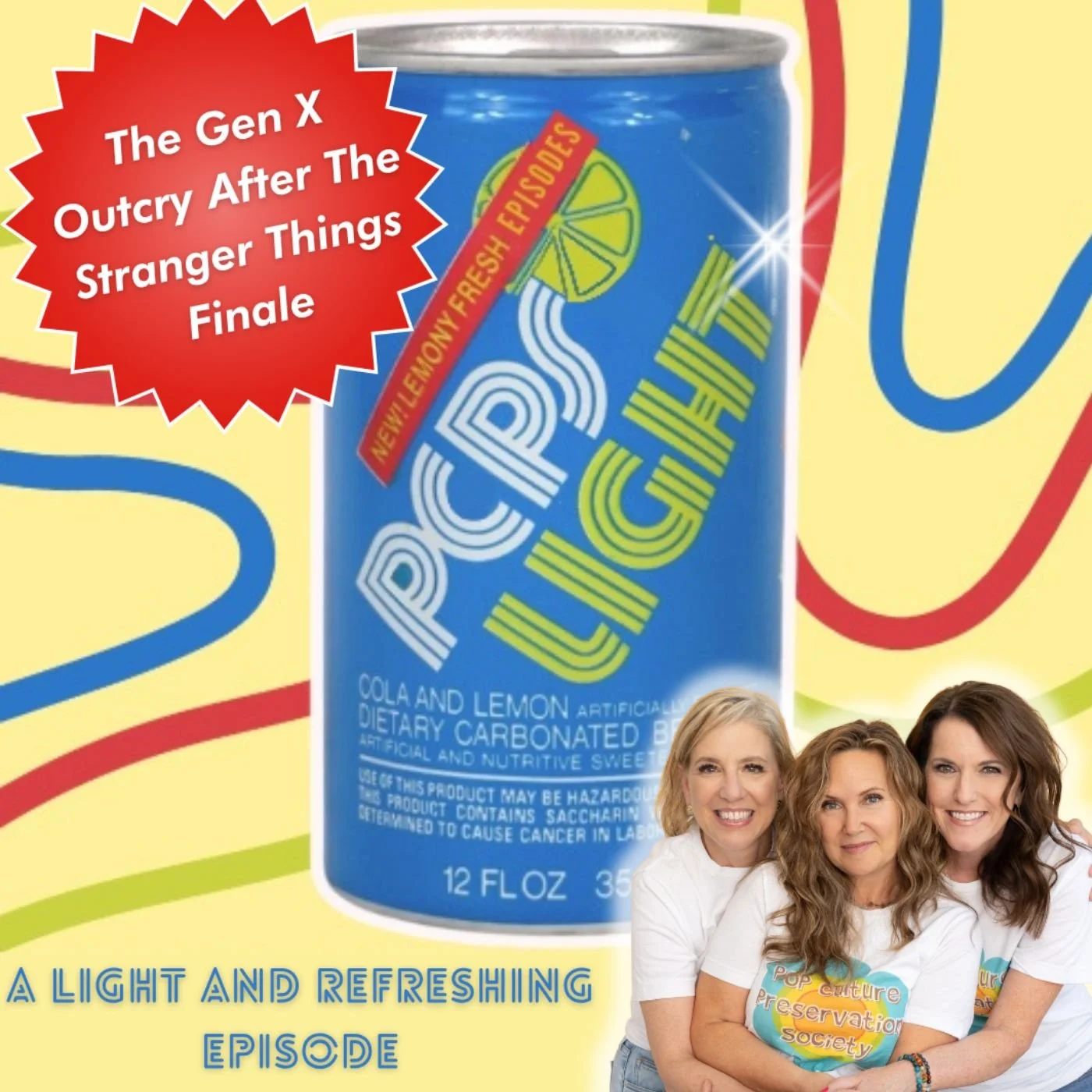
PCPS Light: The Gen X Outcry After The Stranger Things Finale
Speaker 1 0:01
You know when it's right. You know when you feel it, baby. You hold it. You hear it. You taste it. It's right. You got the right one, baby. Yeah. Is this irrepressibly lovable?
Carolyn Cochrane 0:29
Hey, listeners! Today's episode comes directly from the PCPS Vault. Kristen and I recorded this right after the Stranger Things finale aired on New Year's Eve 2025, when the credits rolled and Gen X collectively went, oh my gosh, did you feel that too? Because we felt so seen from the music to all the '80s references, the single moms doing all the things, and gosh, just that general Gen X mentality of fine, I'm just going to do it myself. So while the internet is busy misunderstanding Gen X. We're having a little love fest for our people. No prep, no planning, just Kristen, me, and a lot of feelings. So hopefully you will enjoy today's episode. Let's get into it. Welcome to another episode of PCPS Lite, which will actually be even a little bit lighter because it's just Kristen and I today, and we'll get to why that is in just a minute. Today's episode is happening because after watching the series finale of Stranger Things on New Year's Eve, I knew I had to talk with Kristen and Michelle about it. The Gen X themes were just so apparent and felt really important. So I immediately texted Kristen and Michelle and said, "We need all caps to talk about this finale. I knew I had just watched something special, and after reading those comments on social media by other Gen Xers, I knew that I was not alone. This episode it really deeply touched people in really a lot of unexpected ways, so I send the text. Kristen quickly responds with a yes. Okay, yes, we need to talk about this. Well, Michelle was a little less enthusiastic as she hadn't watched any of Stranger Things because that gory sci-fi stuff just isn't her jam, and we totally respect that. So today's episode of PCPS Lite is just Kristen and I sharing our thoughts and reflections, and we promise no spoilers about Stranger Things the finale. And I also want to point out that you do not have to have watched any of Stranger Things to find today's episode meaningful. Nor do you
Kristin Nilsen 2:41
even have to watch it in the future. We're not even telling you. We just want you to be aware of what has happened. There's been a shift out there in popular culture,
Carolyn Cochrane 2:50
definitely. And we, we as a generation, are being seen. And I actually
Kristin Nilsen 2:56
sorry. I just want to add this really quickly. Is that it's one of the only times that we're talking about current popular culture, we almost always talk about something in the past. Today we're talking about something current because it relates to our past.
Carolyn Cochrane 3:10
Right. There's so many levels to this, and also it is current day pop culture for another generation, and for a lot of us Gen Xers, these would be our children, and so we watched those of us that watched it all the way through would have watched it maybe with our kids, and so there's a lot of meaning. And you watch these kids grow up on the screen while you're sitting next to your child that's growing up and probably launching into another aspect of adulthood. I'll confess, the only reason I actually even watched this finale was because my Gen Z daughter and husband, Grace's Gen Z, right, Kristen? Yes,
Kristin Nilsen 3:48
yes, yes, Tracy. Yeah,
Carolyn Cochrane 3:49
but she and Andy, Grace and Andy, had watched it all along, and they wanted to watch it together on New Year's Eve. And I was sitting there, so I was like, I will watch it with you because, listeners, I have a confession to make. Well, Kristen and I both do. Okay, we are not the people who have watched every single season of Stranger Things, right? We both gave up kind of after season two. I personally, I don't want to speak for you, Kristen, but I am now committed to going back to the beginning and watching it all the way through. I do want to watch it now from the beginning after watching that. Well, and I would
Kristin Nilsen 4:21
much like my much like my comments in at the top. I'm very satisfied with where I landed last night. Having I watched the first two seasons just like you, I started watching with Liam when he was in I think eighth grade because the Stranger Things started in 2016. Yes, and it was fun to watch with him because it was about kids. I was watching it with my kid because it was about kids, and I think I thought it was more about him than it was about me. But by the time the credits rolled on the finale, I was like, No, no, it's not about him. It's about me. It's about me. So I'm very satisfied with my two seasons and. Finale. I'm super fulfilled by the entire experience, and if you guys are inspired to watch it, you should absolutely do that. But don't feel like this is a even even a promotion of you needing to watch it. Just you just need to know what we're all talking about, what the world is talking about, and how Gen X has been affected. How the world has been affected.
Carolyn Cochrane 5:20
Very well said, Krishnan. Thank you. That's exactly what the message I want to get out to everybody, because, like you, really the reason we wanted to talk about this series finale is because something really interesting happened. I think, as Gen Xers and Pop Culture Preservation Society hosts, we spend a lot of time thinking about pop culture and its meaning, and I kept seeing our conversations reflected back at us, both in the finale as we were watching it, and then the way that Gen X was reacting online.
Kristin Nilsen 5:50
Yeah, and that's really, I think, your biggest inspiration was seeing how people were reacting. That people online, people in the comments were feeling emotions. They were having some feelings, and that was really what was. That's what brought you to our little chat. You know, we have our little group chat, and Carolyn was really in her feelings.
Carolyn Cochrane 6:11
Yes, I was screenshotting all of these comments that I was relating to, and I just kept sending them to Kristen and Michelle because they weren't just talking about plot and characters and stuff like that. The people online were talking about childhood, about time passing, about friendships, and you know figuring that out together about the who we were then and the who we are now. It was just this theme that I felt we have been carrying on since day one of the Pop Culture Preservation Society.
Kristin Nilsen 6:40
And I'm actually with Michelle. I am not into gory sci-fi, even fantasy. I'm a very contemporary, realistic, character-driven. That's my media, and it was fun to watch for the first two seasons with Liam. But then I think it got more into what sci-fi fans would would would hold on to, and at that point they kind of lost me. It wasn't bad by any means. If you're into it, it's a very good show, but it's not my kind of show. So I think when you're a person who's not into sci-fi or fantasy and you're still feeling it touch you in some way, I think that's very significant. I think that means that they have done something important that is outside of the story,
Carolyn Cochrane 7:22
100% And I think that that gory, all of that stuff was really, in my opinion, at least like a metaphor or analogy for fear. And that's kind of thing about our generation too. And we've talked about that on the podcast. All the ways that we were supposed to be like scared straight. I mean, we lived during the you know the Cold War, and we everything from things that weren't even real, quicksand, and the stranger danger, and our Halloween candy, and all the things. I mean, we lived in kind of this underlying. It was always there. There was a fear that was always around us as Gen X, and so I think that this gory, yucky monster thing was almost could you know you could say this was something that represented fear, which we know a lot about as a generation.
Kristin Nilsen 8:09
I mean, how many times did I look at my window on the second floor of my house and think about kidnappers opening my window and coming in the window?
Carolyn Cochrane 8:17
Yes,
Kristin Nilsen 8:18
I don't think our children think about kidnappers.
Carolyn Cochrane 8:20
Totally agree, but and you know our culture kind of just doubled down on it and just made us be afraid of any white van that passed or you know anybody just walking by themselves, an adult male walking down the street. I'd be like, "What is he doing on my street? Like this is scary. Everything was to be feared. God forbid
Kristin Nilsen 8:38
somebody ever offered you candy.
Carolyn Cochrane 8:40
Oh my gosh! Are you kidding? I mean, yeah. Or any adult just communicated with you. Yes, that wasn't your parent. Not that there isn't some element to that that you need to be aware of, but at the same time, it was. We were scared straight. I mean, literally. Yeah.
Kristin Nilsen 8:55
But you know what? It didn't come from. This is really getting in the weeds now. It didn't come from a place of caring and protection, unlike where we where we helicopter parents are very fearful for our children, and we we have things that our children should not that we've probably made them afraid of too. But it comes out of our own fear of our children. Like I cannot tell you how many times I've said to Liam, if you are drinking, don't go near the water. Don't go near the water. Every person who goes missing is found in the water, but that's because I'm afraid there is a great story that I'm going to share in another episode coming up, where a parent is leaving their child alone at home so they can go out with their. They're just going. The parents are just going out on the town, but he says make sure to lock the door because there are hippies out there who want to degut you, and it was a control.
Carolyn Cochrane 9:45
It was a way to control us.
Kristin Nilsen 9:47
Oh my God! Yeah, to keep us in line. Uh huh.
Carolyn Cochrane 9:51
Yeah, and to kind of keep their thumb on us, and yeah, we don't have to get way out there. But I think that that's a, you know, a. A way to control any population of people is through fear, and so how do you manage your way through it? And I think this show and this finale kind of show you that you do it together. You do it with a group of friends, and those were some of the takeaways that people were sharing, remembering their their youthful friendships,
Kristin Nilsen 10:25
yeah,
Carolyn Cochrane 10:26
and also recognizing the fact that those don't last forever.
Speaker 2 10:31
No,
Carolyn Cochrane 10:31
like there was this with the the end of the show. There was a kind of a people were saying saying goodbye to their childhood all over again because you realize what comes next, like after this finale was over, you know there's next chapters in real life, and you've kind of been on the other side. Does that make sense?
Kristin Nilsen 10:51
Yeah. And it's interesting. They they this really is a coming of age story, and I'm not sure. Do we need to give like a one sentence? If you haven't seen Stranger Things, it's basically about a group of kids who start out to be like what sixth graders, and then those sixth graders have an they have a set of older brothers and sisters. So those older brothers and sisters would probably be my age. I'm I was class of '86. These sixth graders were probably they they turn out to the class of 89
Carolyn Cochrane 11:23
I think is what it is.
Kristin Nilsen 11:24
So that's the age of the kids. One of the younger kids goes missing, and it turns into a scary hijinks, government conspiracy, supernatural, ghosty thing where everybody has to get involved in fighting the bad. Right. It's not even the bad guy. It's the bad thing. The bad thing to rescue the world from the bad thing, and they, like you said, they do it together. And it, and these are friend groups in ways that John Hughes movies portray, and I. It's friend groups today don't exist in the same way that John Hughes movies portrayed friend groups. It's a little bit different. The pandemic has had something to do with that. Phones have had something to do with that. So it's even the way that this friend group was portrayed is a throwback. These were kids who played Dungeons and Dragons together, and it made them incredibly close. So it's even even the friendships themselves felt like a throwback.
Carolyn Cochrane 12:31
Yeah, for sure, because it was the way they interacted with each other, like the the imagination, just the the things that they did that I I don't want to say our kids don't do anymore, but even my own kids have said like Mom, remember like Andrew when he was growing up. So that's a different generation. He's more millennial, but he was like you know I would just go run around with a stick and I would pretend I was all of these different characters and I don't know that kids maybe they do. Maybe they run around with sticks anymore. But boredom just seems like something we want to get rid of now. Yeah, and that you can't just sit and be bored and use your imagination. And you got to see that play out. These people, these kids were bored together, but they figured out how to manage that and how that could be a yep. And that's
Kristin Nilsen 13:20
where and that's where Dungeons and Dragons comes in. And there was so much of our lives and our growth and our relationships that took place in the basement. The basement was a key place for all. I mean, think about even that '70s show. How much of those relationships were fortified in the basement? And that's the same thing here. There are so many basements in this show, and there are so many good things, bad things. All the things happen in the basement, but it's but it's the kids alone. The parents are never there, coincidentally, or not coincidentally, or maybe ironically. One of the only parents to get involved. You don't see parents very often, but when you do, it's Winona Ryder, who is one of us, right? Right. So the person who was not just a Gen Xer herself, but is the star of reality Bites, which is the Gen X movie of our time, right? And so she becomes the parent. So even though she is involved in the story, she's still separate from the kids, she's not driving the kids' story. She's not. It's not that she's not protecting them. She is Gen X parenting them, so that the kids are really in charge. The kids are independent, and they're taking care of business. Well, I gotta say, Winona Ryder is. She's doing her best, but she's a busy single mom, and she's a little out of her league. She's a little in over her head, and in the end, she does save the day. She saves saves one of the days. She does have a moment with an ax, and you're like, yes, this single mom in over her head finally gets her moment where she triumphs and she succeeds. Seeds, but other than that, it's it feels very Gen X parenty where she's trying to show up for her kids, but she's got a lot going on. She's got a lot going on. She's juggling a lot of plates,
Carolyn Cochrane 15:12
but and and because of that, I think we also realize just how resilient we are as a generation because nobody was step. Lots of times there wasn't an adult to step in and
Kristin Nilsen 15:26
that's right.
Carolyn Cochrane 15:27
Do the thing that that maybe we've made up for with extra as the next generation of parents overcompensated. One thing that I saw online is somebody pointed out that the whole inciting incident of the entire five year series is when this sixth grader goes missing, and Winona Ryder, the single parent, doesn't even know he's missing until the next day. Yeah, you're like Winona, wake up and smell the coffee. But we are talking at that point. It's supposed to be 1983, right? I can see that happening. It was very yeah. That was very realistic and that was some of the fun social media comments and stuff to follow because there were the kids of like following generations the millennials the Gen Z saying what on earth like the mom wouldn't notice the kid was missing and we're chiming in like yeah you know that's very realistic
Kristin Nilsen 16:19
there were even times when I was missing I mean, I wasn't really missing. I would like sneaked out of the house, and my parents knew I was missing, and they're like, "Oh well, that's right. Hopefully, she'll she'll be back. She'll come back.
Carolyn Cochrane 16:32
And I did.
Kristin Nilsen 16:32
I sneaked in the laundry room door,
Carolyn Cochrane 16:34
right? And I'm sure we all have those memories too. Which, gosh, it really stuck with me. But you know, when we were gonna run away, we were gonna pack that Barbie, you know, little case full of all my clothes, and my parents were like, "Have a good life, and just like what? And I just, you know, marched down the the street. So from a very young age, we knew they were like, "You're on your own.
Kristin Nilsen 16:56
How many? I would love to see how many people that happened to, because I also was very disappointed at the response of my parents when I said I was running away. They're like, "Well, be safe. That's
Carolyn Cochrane 17:06
right. Write to
Kristin Nilsen 17:07
us. Nobody begged me to stay. Nobody's like, 'What do you want? I'll give you anything you want. No, they're like, 'Go
Carolyn Cochrane 17:14
right from right then. We thought,
Kristin Nilsen 17:15
yes.
Carolyn Cochrane 17:16
Gosh, I guess we're on our own here, and if we need my mom,
Kristin Nilsen 17:19
like, was that she was making something on the stove, and I remember her being a little surprised, like, "Oh, oh, you are okay. Well, all right. Like she didn't even stop
Carolyn Cochrane 17:30
stirring. Can you just imagine, like our moms at like a PTA meeting or a coffee thing, and it's just like, "Oh, you guys would have laughed so hard, little Kristen. She came into the kitchen with her thing, Carolyn did that too. That was so well. Carolyn's was a better story. She packed her Barbies. You know, these moms are bonding over their kids, attempting to run away. So yeah, so that was really that was a part of our growing up. But one thing I want Kristen to really talk about because not only did the actual scenes in the movie, not the movie, the scenes in the show and the character and the plot line. Those were all important, but especially in this finale, the music made a humongous, tremendous difference in how you emotionally felt, and I think that was something else that a lot of people said. It'd be one thing to just hear these lines without the music that was accompanying these scenes.
Kristin Nilsen 18:29
Yeah,
Carolyn Cochrane 18:29
Kristen, what do you remember? I mean, like, well, yeah, I think this is something you can speak to.
Kristin Nilsen 18:33
Yeah, I have a lot of feelings about that because when it happens, when you're watching the action on the screen, and suddenly Purple Rain starts playing. You wake up. First of all, you're having a really strong emotional connection with not just the song, but with what's happening on the screen. Anytime you add a song and a familiar one, it's going to help you connect, right? So immediately, I'm connecting. But the other thing that you notice is that, oh my God, this doesn't happen anymore. You're just like your heart just swells with our movies of the past, with soundtracks and with familiar songs and how they helped you connect with the with the stories and how many of our feelings about certain movies and certain characters, the ones we feel really really strongly with, about how many of those are because of the music, because the music helps you connect. We are living in a time where a soundtrack is not really a thing. TV shows forget about it, right? So just talked
Carolyn Cochrane 19:30
about that in an episode couple PCPS lights ago. Exactly,
Kristin Nilsen 19:35
it would, and it's very expensive. I understand that, and they threw down the money for the for the songs in this show. So just in the finale alone, they had Landslide. They had Heroes by David Bowie. They had When Doves Cry. They had Purple Rain. All of this is this is when I start realizing. Oh my God, this is not about Liam. This is about me. They are capturing me, and they are reeling me in right now. You might also recall that in the last season, which there's been a lot of time between seasons. So in the last season, which was in 2022, the Kate Bush song "Running Up That Hill" was resurrected, and it went to I don't know if it went to number one, but it was it went to a really high number, much higher than it did when it was originally released. Yeah, it was in the
Carolyn Cochrane 20:24
zeitgeist, as you like to say. Everybody was talking in the zeitgeist.
Kristin Nilsen 20:27
Zeitgeist. It was a global hit again for Kate Bush running up that hill, and that was the first time that had happened. And for Kate Bush, of course, she's like, "What? Thank you for your things. And it just showed how TV and media can be a vehicle for making hit music. So I don't know why more people aren't trying to do it. So it looks like the songs from the finale are seeing a huge bump, like a you know, Purple Rain had like a 1,000% jump in streams. It's it's is having a huge bump when people hear that music, it makes them go listen to it again, and it makes you connect with with the show. The thing that's really interesting is that the people who created this show, the Duffer, Duffer, not Duffy, Duffer, right? The Duffer Brothers, they are millennials. They are not Gen Xers, but they do consider themselves children of the '80s, and so when they're looking for the music, they are thinking personally about you know what what were what was the music that was going on when we were kids? What what were the songs that everybody was excited about, even if we were too young? And they really nailed it. I mean, who among us does not shed shed a tear when you hear landslide?
Carolyn Cochrane 21:45
Oh yes, and and what it means in those moments, and yes, mean time passing and growing up and all of those things. And I I believe this was one of the comments that I screenshot and sent to you, Kristen. But I think this sums up a lot of why of why it was so emotional for many of us Gen Xers when we heard the music, and this person said, "This is Maria 316 on Threads, and she said one of the most beautiful aspects about Stranger Things is how deeply it understands the role that music played in the 80 s. Music wasn't just background; it was identity, escape, comfort, rebellion, and connection. It lived in our headphones, our bedrooms, our friendships, and our feelings. Artists like Prince didn't just soundtrack our lives; they helped shape who we were. That's why the music choices in this series feel so personal. They're memories, not just songs, and I have the chills just reading that.
Kristin Nilsen 22:42
I do too. That I love it when people can pick something out and really emphatically say what it is. Like I think that's what you wanted me to say, and I couldn't do it as well as she did. I think you said
Carolyn Cochrane 22:54
all things that are related to this, and I think it's true. But I think it is that part that you say again throughout our journey of this podcast, whenever we talk about music, and that to me is kind of your wheelhouse-the music stuff-and that's what you have always said. It is more than just a song that's playing in the background. It is part of who we are and who we were then, and that's why you know. I mean, there are certain songs we can hear, and it's like, oh yeah, I kind of know bebop bubbed. But there are other ones that they were our identity. They were all around us, and they they helped bond us with our friend group. They yeah, it was everything. And I think for you, I would say that Prince was very much one of those artists that formed our Christianity cannot
Kristin Nilsen 23:42
cannot be underestimated because, and as you've heard me say 1000 million times before, it wasn't just that it was the music that was everywhere, and that not just I was listening to, but all of my friends were listening to. Everybody had the cassette. Everyone had it in their car. Everybody had it in their boombox. We listened to it all the time. But also, this is growing up being a teenager in Minneapolis, right? So talk about identity, right? Right. It was the identity of who we were and where we were growing up and what our home meant to the rest of the world. And oh, this is what people are thinking about now when they hear the word Minneapolis. They're thinking about when doves cry, and they know that cool shit happens here.
Carolyn Cochrane 24:21
That's right. That's right. We needed a little bump after Mary Tyler Moore. It's like, okay, let's put Minneapolis on the map. That's right. But I love
Kristin Nilsen 24:29
what she says about how having that music in the show validated how important music was to our lives as teenagers. Because again, I don't know if we could say the same for other generations. Maybe, maybe yes. I don't know. I'm just saying. I I would like somebody answer that question for me. Did we connect with music, and did the music landscape lend itself more to creating the fabric of our lives than other generations? I mean, if you think about it, we were the first ones to have MTV, and so that. Played a really yeah well although you can still you can still get classic MTV which is even better. It we were we were connecting with music 24/7 not in a not in a Spotify streaming way but in a boombox way right like now you could roller skate down the street with your boombox on your shoulder, and you told people what you were listening to, and I love that. I used to love to walk around the lake and hear what was coming out of people's radios and boomboxes because I was listening for the song of the summer. What is the song that is coming out of everybody's boombox? That's the song of the summer, and I and I don't know that we've had a song of the summer for a really long time. I don't
Carolyn Cochrane 25:46
know either because it's all just in people's air but you know AirPods and in their ears, and we're not. It's not a communal experience. I mean, you know, we have our Taylor Swift things or whatever, but I don't. I don't even see Grace getting excited like all my friends come over to my house. I got the Purple Rain album, or I got the Grease album, and we're gonna sit and we're gonna put it on and we're gonna listen to it all together in community physically, like not just we're all listening and then texting each other back and forth or whatever about how great the Taylor's new Taylor Swift drop is. It's like we did it in community a lot more
Kristin Nilsen 26:22
very much yeah and then even if you think about just roller skating alone there's nothing more communal except maybe church right like roller skating was our church and you can't have roller skating without the music right so it makes you wonder if Stranger Things had not had these songs so carefully chosen, would we have connected in the same way? Because would it have not felt as authentic? Did it up the authenticity?
Carolyn Cochrane 26:51
Well, I think yes, for so many reasons. And you talk about this a lot in the podcast too. Is that when those songs were playing in real time, the the Purple Rain songs and how old we were at those times, and you talk about the reminiscence bump and all of that. We are not only experiencing the feelings; it's just everything that was happening to us in our lives at that time gets brought up when those we hear those notes. I think, and so the fact that it was an emotional scene happening on the screen in the series finale, and they're playing this song that's full of emotion and very similar emotions that are that are being reflected on the screen were the ones we experienced at the same time. Yes, so it's mirroring it exactly, and it's this double kind of like because it's so natural. Like we don't we don't say oh I'm gonna put on Purple Rain. I'm gonna feel this way. Like we didn't know that's the song they were gonna play, and those were the notes we were gonna hear. But immediately when those notes happened, we, as my therapist would say, there's a somatic reaction even before you realize what is happening. Your body is, you know, something's coming up in you. Yeah, your body reacts to your. Your body does
Kristin Nilsen 28:01
think about so. I'll just tell. I'll set the scene for you just to emphasize that point. Purple rain comes on at the moment when the couple is like, are they going to do? Are they going to have to separate? They love each other. We can't. No. Yes. Stay. Kiss. Hug. Kiss. Cry. Don't leave me. Cry, hug, kiss. Okay, I'm 16 when Purple Rain comes out. That's exactly what I was doing at that moment. So it's like a double reminiscence bump.
Carolyn Cochrane 28:34
Right.
Kristin Nilsen 28:35
It's not just the song. It's the song and the life experience being mirrored back for me. My song that went along with that experience, and
Carolyn Cochrane 28:43
I think that, if we could even say it more articulately, I don't know how, but I think that is what really hit people unexpectedly. Like that's what was some of the the emotion and the reaction when the the show was over. It was it was a lot of that that I don't even know we can put words to, and I don't know that we have to because it it was so just in us, and it was so emotional, and it was like reliving it. A lot of people saying their comments over again in a different way because you know how it's going to end now. You didn't really know then the first go round. You know, we thought certain things might happen a certain way. We were, and that maybe it doesn't always happen that way. But that's real life.
Kristin Nilsen 29:26
Yes, it absolutely. And we are the ones who take we're we Gen Xers took hard knocks. Yes, that was part of our growing up. Our parents didn't protect us from the hard knocks. Whereas we, I'm going to cop to it. Like you'll do anything in your power to make sure that your kid doesn't land too hard, and to protect them from even heartbreak. Like I swear to God, there have been times I'm like Kristen, this is not your place. I know. I'm right there with you. Whether it's friend drama, just let this go the way it's supposed to go.
Speaker 3 29:54
You can't do anything about this. He's going to cry and call
Carolyn Cochrane 29:57
that girl's mom and say what meaning she is.
Kristin Nilsen 30:00
My daughter, right, and my parents barely even knew what was happening, because it it wasn't it wasn't that we had bad relationships with our parents. We just didn't share with them, right? We didn't share a life with our parents the way our kids share a life with us. It's just very different, and I think that is part of the theme of this entire series, as well, is that you have the gang of kids, whether it's the middle schoolers or the older brothers and older sisters. These two little gangs who are in charge of all of the action and all of the rescuing. Everything is happening without the help of adults, and this is very-you'll get a very ET feeling from this show. Very Goonies feeling. Those two shows, both Steven Spielberg, are all about kids taking care of business without any help from the adults. And actually, the adults are getting in the way. The adults are not helping, and that happens here, of course, too, and so it feels like a throwback in that way too. Not just in the movie making, because it's it's a tribute to these styles of movies that we had a lot of back in the '80s. But I think that style of movie making also represented who we were. We were little gangs of kids roaming around and kicking ass, and
Carolyn Cochrane 31:20
I
Kristin Nilsen 31:20
don't know that we have little gangs of kids roaming around and kicking ass anymore, and so that made it. I'm sorry. Go ahead. Looks like you were like
Carolyn Cochrane 31:28
no, no. I love how you say that because one of my favorite things that again I screenshotted it was someone else's comments. Lucy Lucy Penbrook author, and she had a whole. I guess you call it a thread, a whole series of comments, but one of the things she said about that time period of our lives, she said it was when fear was real, but hope was bigger. When problems felt solvable because you weren't facing them alone, and then she said, and maybe that's why this finale and everything mattered so much. It reminded us that the courage we had then, we didn't lose it. We just forgot where we put it. Amen. Bring on
Kristin Nilsen 32:05
God. I
Carolyn Cochrane 32:06
just that makes me. That was such a hopeful moment or thing that I read, and I thought, yes, that's also what I left with with that at the end of that finale. Is it was there was hope, and I feel a little more hopeful about this awful world that we're living in right now. Like, guys, remember we did this before. We did this with our friends. We got through some really hard times, and what you know in the show. And we and we did
Kristin Nilsen 32:32
it all alone. I mean, without with our friend group, of course, but without the help of adults, because we simply weren't telling them that our hearts were broken, or we had failed something, or like whatever the you were being bullied. You just didn't ask for help. You just did it. And I look back at my my like adolescence, my childhood. I never thought that I couldn't do something. I never thought I'll never be able to do this. How will this go? How will this work? Oh no! This now we're screwed. I never thought that. I'd be like, ah shit! Come on, let's go kick some ass. Like whatever, no matter how small it was or big it was. I always thought, well, I guess I got to take care of it. Right. And you could say that that is emblematic of our generation. That maybe wasn't of our parents' generation. It certainly isn't of our children's generation. Most of you probably get phone calls from your kids, and they're asking you what to do. And I'm like, I know exactly what to do. All right, like I created it. I copped it. I made that happen. It's not them. It's us. Right. So if we any any time we complain about Gen Z, we know we made that problem. So I totally own that. But the other thing that was so interesting about the, you know, roaming around and kicking ass and having hope and always knowing that you can get to the other side, there was never a chance that I wasn't going to get to the other side, and I wasn't a Pollyanna by any means. It was more like you're gonna
Carolyn Cochrane 34:03
figure it out.
Kristin Nilsen 34:04
Come on,
Carolyn Cochrane 34:05
right?
Kristin Nilsen 34:06
You're just gonna do it. You're just gonna figure out how to do it, and you're not gonna ask for help, and you're just gonna do it. But one thing that really stood out about this show, and I'm I've not seen anybody write about this. Maybe there is writing out, but maybe there is, and I just haven't dug into the research enough, and I don't know if it was on purpose, but it was significant. Is that the leaders of the pack and the ones who did the kicking of the ass were 100% female?
Carolyn Cochrane 34:35
Amen, hallelujah, 100%
Kristin Nilsen 34:37
female. Yeah, the Captain Americas were the women, and it's not just one. It's not like, well, here's our Wonder Woman. It was, you've heard the name 11. She's the star of the show. She's the one who has to kill the bad thing. Then you have Nancy, who is the leader of the older brothers and sisters, and she's the one who is like, come on, follow me. Here's this. Here's this one. I'll be the distraction. You go over there. She's giving all of the direction. There's the younger sister who's what, 1112, who's leaving, leading a pack of small children away from the bad guy, and she's like, "Everybody, keep your eyes on me. Follow me. We're going into that cave. And she kept saying, "Everybody, eyes on me, eyes on me, and I'm like, that's me, that's me at 11 years old. Eyes on me, everybody. Believe it. And then at the end, the mom who is you know nominally involved, except that her child is missing, and that's scary. At the end, when she gets the ax and she gets to level that final blow, it's like her moment. She, at the end, is able to shut the whole thing down, and she's and she evens she's like, "You picked the wrong family to fuck with. Like she just let it fly, and this was previously a woman who had trouble finding her place in the world, and so I have a feeling that, well, of course it's on purpose, but I don't think it's pandering. I don't think it's feminism. I think it's an acknowledgement of the fact that in the '80s, in particular, 50% of the households were led by women, and whether or not they were, you know, there was benign neglect or not, they put food on the table and they went to work all day and they got you to school and they paid the bills and they took care of everything. And then you saw your dad on the weekend.
Speaker 2 36:30
Yeah,
Kristin Nilsen 36:30
sorry, dads, but that was the 80s, right? Yeah, maybe you wanted to be more involved, but there, you know, the courts, whatever. There were, and even in married couples, the same thing. The moms were making it happen.
Carolyn Cochrane 36:44
Yeah, and I think the dads, my dad, would be the first to admit it. Oh, my dad
Kristin Nilsen 36:48
would too. Absolutely, it was,
Carolyn Cochrane 36:49
and you know, it's it wasn't even like I don't want to say he didn't appreciate it, but it was just so expected that it was just like that's the way it is. Where you know, I mean, let's face it. At least for me, I'm appreciative of when Andy, especially when we were young parents, when he did step up and do things that my mom had, you know, that you would associate with. That's that's what moms do. But and I was like, oh my gosh, I have the best husband in the world. He said he's going to clip their toe, those babies' toenails, and he's gonna give them back every night. And I just thought he was a saint, where you know, like, well, if you did it,
Kristin Nilsen 37:26
you wouldn't be a saint. You would be meeting expectations. Yeah, just barely meeting expectations.
Carolyn Cochrane 37:32
Exactly. But
Kristin Nilsen 37:33
really, the moms keep the boat afloat.
Carolyn Cochrane 37:34
Oh yeah, I mean, and I think acknowledging that, like giving them that role in the show and beyond just keeping it afloat, like this is so obvious you can't deny this now. People, after you watch this finale, and I'm just going to say one more comment because this kind of sums up all of those groups or people that are maybe shunned or not acknowledged or whatever you want to say. Then and now, the Duffer Brothers really did say, "Here's two strong woman, women to your point, Kristen, compassionate men,
Kristin Nilsen 38:07
which I think,
Carolyn Cochrane 38:08
oh yes, 100% real friendships, freaks, geeks, and outcasts. These were kind of the nerdy kids. A lot of them were
Kristin Nilsen 38:16
the Dungeons and Dragons kids.
Speaker 3 38:18
Yes,
Kristin Nilsen 38:18
yeah,
Carolyn Cochrane 38:19
strong black characters,
Kristin Nilsen 38:20
yes, gay
Carolyn Cochrane 38:21
pride, and in the end, really love, love wins. It really does.
Kristin Nilsen 38:26
It really does, 100% No matter what kind of love that is, you know, platonic love, romantic love, familial love, all of it, 100% That is absolutely true. And the number I also noticed it was incredibly noticeable how often the boys and the men cried in this finale. Yes, there was a lot of crying, and I kept thinking, how is it that we can have this portrayal of the compassionate men who show their feelings, and we have a problem with masculinity in America? In America, just watch Stranger Things. Right, express yourself, get sad.
Carolyn Cochrane 39:01
Look who wins in the end. Look who you know. We we can do this, people. Yeah. I just felt very hopeful and very seen, which is something that I think we all want as as people and individuals, and I think as a generation and and as a person, I felt seen. Like somebody gets it, and gets what we've been saying. Like we haven't been making this shit up, Kristen. We might not have doctorates in Gen X stuff, but we have been saying maybe maybe the Duffer Brothers have been listening to our podcast over the past five years. That's possible. They've gotten some some scoop from us because I really think we saw some things played out that we have discussed from the very beginning, and that's what really made me feel like we needed to talk about this on the podcast
Kristin Nilsen 39:49
because we need we we obviously bring attention to Gen X, but this we need to amplify when other people are talking about Gen X because we of course are the overlooked generation. Whether it's you know the boomers on one side and the millennials on the other and everybody's got their problems and everybody's got their thing to say and nobody seems to want to hear what we have to say even though who's driving the bus who's like I said keeping the boat afloat I'm I'm just gonna say it I think Gen Xers the people like 45 to 60 are basically the people who are keeping things afloat, and we don't get the credit for it.
Carolyn Cochrane 40:24
Well, I think we're going to be the generation that says you need to give credit to yeah to people in this age group too. Like you know, my mom. We were looking at pictures the other day. My mom was showing me when she got married, and my grandmother was 60, and she's like, "Your grandmother was 60 in this picture. Oh my God! Gosh, I mean, it was like Aunt B from Mabel RFD to the hill, and I thought 60. So just the fact that we are, as a generation, redefining what that looks like for everybody, particularly for women, and that we have this really unique knowledge because we lived what we were watching on Stranger Things, so we have that experience, and we can now acknowledge that, and then kind of that we've come out on the other side and bring that to it too. This perspective, and people are going to listen. You know, people are starting to listen, and I don't. I think we're the first generation that's saying, "I'm 50. I'm in my 60s, and this is the time of my life. I know my shit now,
Kristin Nilsen 41:27
and I've got something to say
Carolyn Cochrane 41:28
exactly.
Kristin Nilsen 41:29
And as I've said this so many times in the podcast before, when I'll be doing something, saying something, wearing something, and Liam will be like, "Mom, people don't really do that anymore, and I'm like, "I'm people,
Carolyn Cochrane 41:39
right? Am I not people?
Kristin Nilsen 41:40
My friends are people. My friends are wearing this, and we are people. So don't tell me that people aren't wearing it, as if us wearing it means that it's not a thing. It's a thing because we are people. It's interesting that you bring up the you know the Aunt B look and what 60 used to look like and what we're doing to change people's perceptions of that. Because I'm reading a really great book that I got from a listener at at our live recording, and it's called Generations. It's by an author named Jean Tweng. I hope I'm saying that right. T W E N G E. We'll put it in the show notes. Generations, and it's really an examination with data of what every generation really is like according to the numbers, and one thing that she says about Gen X is that we have both a very short childhood and a very long adolescence, which means we grew up super fast. We were adults way before our time because of all the things that we've just talked about here. Latchkey kids, parents are working, right? All of the things we're taking care of, stuff we're taking care of our little brothers and sisters. So we had a very short childhood, but we also didn't get married when we were 20, and we didn't start having babies when we were 22. I mean, some of us did, right? But for the most part, we were the first generation who said, "I don't. Let's just live together, or "Let's get married when we're 30 or 35, or maybe you know, if you're like me, you got married when you were 26, but you're like, I don't really want to get a job
Carolyn Cochrane 43:07
as women. Let let we're gonna graduate college and we're gonna get jobs.
Kristin Nilsen 43:11
We're gonna do some fun stuff, and then when I'm 34, I'm like, I'd better have children soon, or I'm or I'm gonna be on that list of like, what is the advanced maternal age or whatever
Carolyn Cochrane 43:22
geriatric pregnancy.
Kristin Nilsen 43:24
Even though I was married, I still count that as adolescence because I always say Mike and I were just girlfriend and boyfriend until Liam was born because we were still just doing adolescent things. And so she says that's the reason that we have taken our look into we've changed the look of a 60-year-old because we have had a slower adulthood. We are aging slower. No matter what is happening with our bodies or our health, regardless of that, we are still wearing the cool shoes and we are doing fun things with our hair. We don't have any shoulds about what we're supposed to look like at age 60. Whereas I think our grandmothers felt that it was appropriate to you know get the little hair helmet and wear the auntie dress and right you had to look a certain way. Whereas we're like, I just kind of want to wear this, and so she says that you are correct that we are changing the perception of what 60 looks like, what 50 looks like, what 70 looks like, even.
Carolyn Cochrane 44:27
Yeah,
Kristin Nilsen 44:28
that's us. That's us. We're doing
Carolyn Cochrane 44:30
that. Great. We are great.
Kristin Nilsen 44:31
Yeah.
Carolyn Cochrane 44:32
Okay, I'm going to wrap it up. Are you ready to wrap it up?
Kristin Nilsen 44:35
Yeah. The only thing that I will add before we wrap this up,
Carolyn Cochrane 44:38
okay, is
Kristin Nilsen 44:38
that it's really fun to watch how they do the sets, how they do the costuming, how they do the hairstyles, the glasses. Whoever was in charge of buying the glasses, the 1980 s glasses, you need a raise because they did. They had Christy Larson's exact glasses. Remember when you put a little sticker like your initials. The corner of your lens, they had the jams. Remember wearing jams? Those long, really loud shorts. Yeah. I remember. I thought I caught out at one point. Somebody grabs something and they say, "Do you want a drink? And they hand something to somebody, and I think, "Oh my God, is that a water bottle? No, no, that was a thermos. That was a thermos, and I was like, I had to clap. Like, good on you, good on you. So, some of some of the hair was a little wiggy, but they had really good intentions. Like, let's. This person has a perm. This person has a mullet. This person, you know. Let's not
Carolyn Cochrane 45:36
forget. You know, this was small town Indiana. That's right. And you know that we grew up in suburban metropol, you know, of metropolitan area. So, who knows about some of the the choices? I mean, it could have been very Indiana small town kind of a thing, but who
Kristin Nilsen 45:56
knows? Yeah, I just
Carolyn Cochrane 45:57
think that yeah, like you said, the sets, and it's a lot of the stuff that's not set that you absorb anyway, even though it's not like in the forefront. It might be a background character or the color of a locker or a poster hanging somewhere. That it's just it creates that environment, and it it just was a really fun way to say I feel seen. Like that was me. I it didn't. It's not forgotten. I mean, that's the other thing we talk about a lot on this podcast. Is we're still here. Let's not forget us, and we're pretty cool, and we're saying important
Kristin Nilsen 46:31
things. I will say that the end. By the time you get to the end of the finale, again, remembering I'm not into sci-fi. I'm not into action. This is not my deal at all, but they did a legit credits sequence at the end, and I think that was a gut punch. The movie comes to a close. The credits begin with shots of all of the different characters over time, almost like a patchwork, patchwork sort of scrapbooking effect, showing all of the characters throughout the entire series playing David Bowie's heroes. And at that moment, I was like, "Yeah, we can be heroes. Oh my God, this is the theme of the entire series. We can be heroes, and we are. Look at us,
Carolyn Cochrane 47:20
right?
Kristin Nilsen 47:21
We have a freaking podcast.
Carolyn Cochrane 47:23
Well, exactly, and we can be who we were meant to be. Like we don't have to become something else to be a hero. We don't have to fit somebody's mold of whatever that looks like for society or whatever. It's like we can live into who we're meant to be, and we're we're the heroes. Amen. Hallelujah. It was very hopeful.
Kristin Nilsen 47:42
Yeah, it really was.
Carolyn Cochrane 47:44
I love it. Oh,
Kristin Nilsen 47:45
thanks for chatting with me about
Carolyn Cochrane 47:47
this. Thank you, Kristen. If for if no one even listens out there, or you're not even with us anymore, this was so therapeutic for me. I just needed to verbalize some of these things that I was experiencing and feeling after that finale, and to know again that I'm not alone, and that we we're all in this together, and we all have a part to play, and we don't have to change, and we're we're important. We are important, 5060, year olds. I mean, I'm the oldest I know of this generation, and damn proud of it. And I don't think anyone would think I was 60 if they didn't know better.
Kristin Nilsen 48:22
Well, and what does 60 mean? You get to decide
Carolyn Cochrane 48:25
exactly. If that's nothing else that we come away with from today's episode, it's that we get to decide who we are. So as we wrap this up, I think that Stranger Things really gave us. It just wasn't an ending to a show. It gave us a quiet moment to look back and say, yeah, that was real, right? And that that happened. Those that childhood, those friendships, that feeling of figuring things out together-like we can do this. Yeah, what a hopeful way to end that show, and what a hopeful way to go into 2026 with some of the stuff that's going on. I feel really uplifted, and I'm so glad that you chose to share some of this conversation with me, Kristen, because I really needed to have it. It
Kristin Nilsen 49:07
was good. It was very therapeutic. You're right, because we can be heroes.
Carolyn Cochrane 49:11
Yeah. Oh, I love it. I love it. Well, until next time, you guys, be kind to your energex kid, because we're we're all there and we see you, and we'll see you soon. Cheers. Bye bye. The
Kristin Nilsen 49:23
information, opinions, and comments expressed on the Pop Culture Preservation Society podcast belong solely to Carolyn, the crushologist, and Hello Newman, and are in no way representative of our employers or affiliates. And though we truly believe we are always right, there is always a first time. The PCPS is written, produced, and recorded in Minneapolis, Minnesota, home of the fictional WJM Studios and our beloved Mary Richards. Nanu nanu, keep on truckin' and may the force be with you.