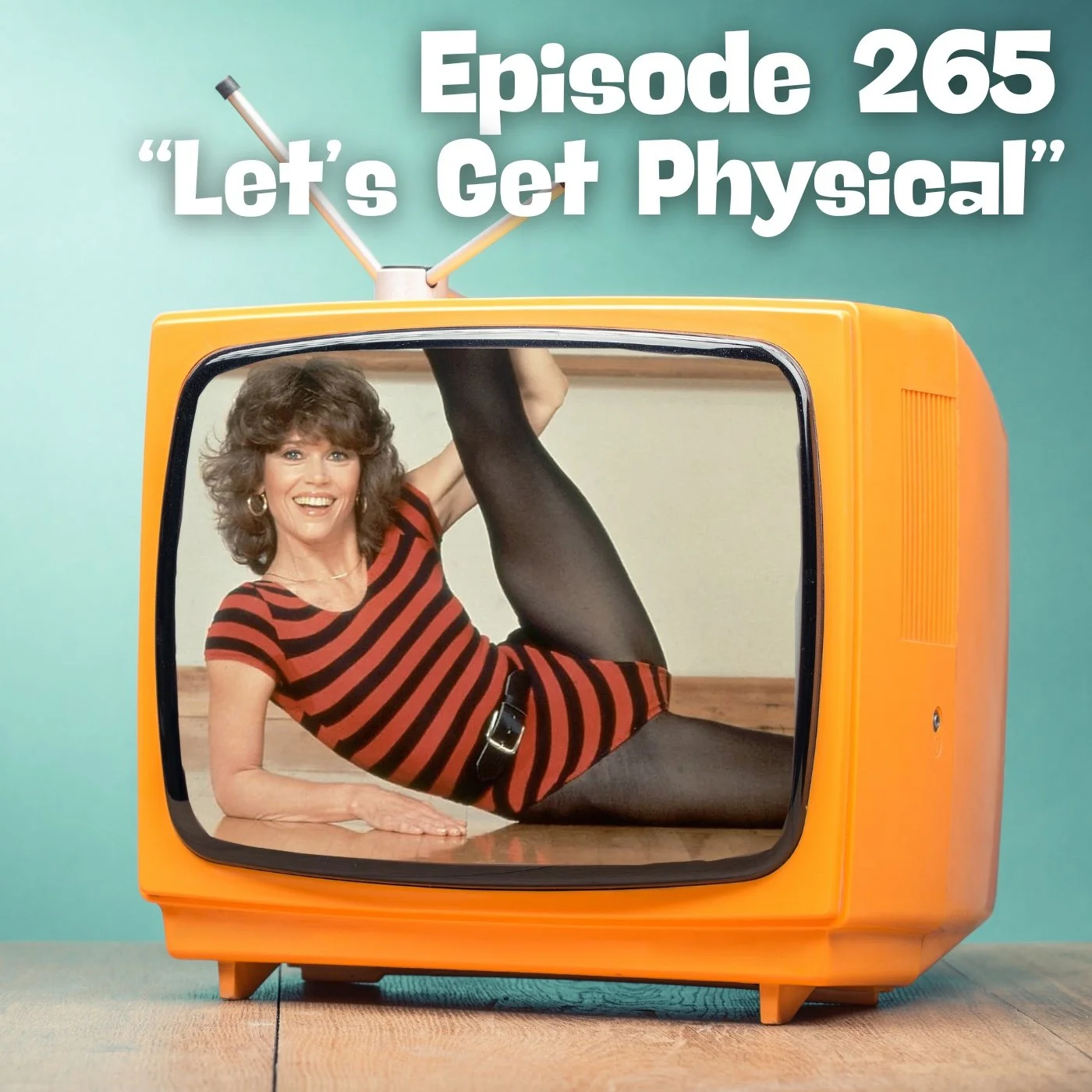
Let’s Get Physical
Kristin Nilsen 0:00
Welcome to the pop culture Preservation Society, the podcast for people born in the big wheel generation who were the first people to turn their living rooms into aerobic studios with the addition of a 20 pound
Michelle Newman 0:10
VCR, we believe our Gen X child has gave us unforgettable songs, stories, characters and images, and if we don't talk about them, they'll disappear, like Marshall will and Holly on a routine expedition, and
Carolyn Cochrane 0:22
today we'll be saving the glorious sweat band soaked moment in the 1980s when America pushed the coffee table out of the way, popped the VHS into the VCR and collectively decided that exercise should involve neon spandex, enthusiastic grapevines and a whole lot of feel the burn. I'm Carolyn, I'm Kristin,
Michelle Newman 0:45
and I'm Michelle, and we are your pop culture preservationists.
Carolyn Cochrane 0:58
Okay, you guys, before we get started, I need you to get in the right mindset, because today we are going full 80s fitness. And Michelle, for our YouTube viewers, is in the full 80s mindset. She is donning her side pony tail, her furry sweat, sweat band, head band thing. I'm not sure what that Oh, I know my makeup today, the Flash Dance ripped t shirt look and a happy green dumbbell.
Kristin Nilsen 1:32
That's the name of my new restaurant,
Carolyn Cochrane 1:36
my stripper, yes, so we're talking neon leotards, leg warmers, maybe like Michelle a slightly aggressive headband and absolutely no shame, because this is peak Jane Fonda VHS in the living room energy. But honestly, there's a reason this era stuck with us. This is when at home, fitness really became a thing. It was fun, it was accessible, and it made you feel like you were part of something, even though you were maybe just by yourself in the living room. So yes, this era also planted a few seeds when it comes to how we think about our bodies and fitness, and we've talked about that before. Today we're going to kind of stick with the fun part, okay, the music, the energy, the slightly ridiculous moves that we embraced, and we embraced all of it, you guys. So this is your permission to not take yourself too seriously, to turn up the music, lean into the nostalgia, and just move your body. And if you feel the urge to yell, stop the insanity at any point, we support it.
Michelle Newman 2:36
All right, ladies, let's do this. Okay, get your buns in the air. Everyone like we don't buy
Kristin Nilsen 2:41
the seal in the air wave your bum
Carolyn Cochrane 2:43
so long before neon leotards and VHS tapes took over our living rooms, the idea of working out at home actually goes way, way back. I was surprised. Get a load of these fun facts, ladies, all the way back to the late 1800s so in the late 19th century, there was a movement. It was called physical culture. It began in Europe and quickly spread to the US, and it began really promoting strength and health and discipline, especially for at that time the growing middle class. There was a man named Jugend Sandow. Okay, he was often called the first bodybuilder, or the world's first bodybuilder, but he entrepreneurially sold mail order fitness guides, dumbbells and even early versions of home gym equipment.
Kristin Nilsen 3:31
This is like, can you remember those? I now when you say that 1800s and bodybuilder? Now I can see the pictures in like Guinness. In the Guinness black and white photo, yes, of a guy with muscles and suspenders, or whatever,
Michelle Newman 3:48
looks almost like suspenders. But then it goes into like, like underwear, like tidy, right?
Carolyn Cochrane 3:54
And it started primarily because industrialization was happening, and it was people were just sitting around more, they weren't as active, and you
Kristin Nilsen 4:02
know, they weren't plowing the fields in Right exactly.
Carolyn Cochrane 4:05
And suddenly exercise became something that you had to intentionally do, rather than just being built into your daily life. And this was perhaps one of the most interesting things I came across. Fun fact that some Victorian homes actually had built in pulley systems and resistance machines, basically, peloton great, great grandparent.
Kristin Nilsen 4:27
Oh, my God. But again, I can picture it like the woman in her long dresses, like pulley, pulley, pulley, pulley, right? Yeah, yes, okay, all right, I can see it.
Carolyn Cochrane 4:37
So here we go. We've it's in our homes now. And by the 1920s fitness actually entered the airwaves. There were daily exercise programs that were broadcast on the radio that guided listeners through routines in real time. I want that now, yeah, well, you can't. You're an app the radio.
Kristin Nilsen 4:59
Okay? That's okay,
Carolyn Cochrane 5:00
all righty, there you go. Well, yeah, so there weren't any visuals. You just kind of used your imagination. So I can only imagine what I would have been looking like because I was at Pilates this morning, and she says there are visuals. She walks you through everything, and I'm always the person that she comes over to, and it's like, now your right leg extended, you know, I've got it in the air, but it's both like leg Carolyn, yeah, pretty much. So I can't imagine what I would have looked like back then, in my in my house listening to that. All right, so that's kind of the airwaves. We've got the radio. But then came one of the biggest pioneers of at Home Fitness media. We get the TV. Here we go and we get who do we get? Kristen, Jack LaLanne. We get Jack lane.
Speaker 1 5:46
My name is Jack LaLanne, and I'm here for one reason, and one reason only, to show you how to feel better and look better so you can live longer with
Kristin Nilsen 5:54
his little ballet slippers, yes, and
Carolyn Cochrane 5:56
his little, cute little outfit, and he launched one of America's first televised workout shows, inviting Americans, especially American housewives, to exercise along with him in their
Kristin Nilsen 6:08
living rooms. And it was very calisthenicky. It was, and I would just, I never did it. I just watched it.
Carolyn Cochrane 6:15
I watched it too, but I do now that you said that, when you said calisthenicy, I don't know if my mom was doing it, and I kind of watched her if it was just on, but I do just on, but I do remember I was probably, like, in second grade or something. But I thought when I get up in the morning, I need to do like I did jumping jacks, and I did some sit ups, yeah, like, I think from watching that, I thought that that should be something I did get a jumpstart on my day that
Kristin Nilsen 6:40
he like, there were no jumping jacks before Jack.
Carolyn Cochrane 6:43
Lalanne, no, I didn't. Is it called a jack because of his name?
Kristin Nilsen 6:49
I'm just assuming we're
Carolyn Cochrane 6:50
gonna go with that really
Kristin Nilsen 6:53
popularized the jumping jack. Okay, so maybe it did exist, but he popularized it. They just called them jumpings before. And he's like, yeah, it's a jumping jack. But think about it, like in gym class, everybody did jumping jacks. Oh, jumping jacks
Michelle Newman 7:07
are a great exercise. It's your whole body.
Kristin Nilsen 7:09
He did it in his little ballet shoes.
Carolyn Cochrane 7:11
And it really caught on in the 1950s because this is post war suburban life. You know, more housewives staying at home, and we've got more TVs. And we've got this now starting to be a cultural focus on health, appearance and longevity
Kristin Nilsen 7:27
well, and you have, yeah, you've got to look lovely for your husband when he comes
Carolyn Cochrane 7:30
home from the office. This is you've
Kristin Nilsen 7:32
got to maintain your figure,
Carolyn Cochrane 7:34
indeed, which, sadly, kind of continued. And just as we'll talk about a little bit so the 60s and 70s roll in and at home, fitness, then it starts to become more commercial. It's more accessible. There are programs like slimnastics,
Kristin Nilsen 7:49
oh yeah, slimnastics, I totally forgot
Carolyn Cochrane 7:52
about that, of course, targeting women specifically, often emphasizing grace and weight loss over strength. And there were workout records, yes, vinyl. And I do remember my mom having a paperback guide had, like, exercise and maybe it was a Jack LaLanne book, yeah, not that. I think about it, but you could go on and it showed you, like, step by step, how to do the
Kristin Nilsen 8:13
different moves, how to do a donkey kick.
Carolyn Cochrane 8:15
So we've got that happening. And now we also start to see quirky exercise equipment kind of coming into the home. So now it's not just our jumping jacks and sit ups and that kind of thing we're seeing, like the machine. One of my mom's friends said the one that went around your butt, yeah, is
Kristin Nilsen 8:33
that exercise? What are you just shaking
Michelle Newman 8:37
the cellulite? It was to shake your cellulite off that looked
Carolyn Cochrane 8:41
so incredibly interesting to me, but also kind of dangerous. And I used to think, like, what if it slipped? And, yeah, yeah, so there was that. And I don't know if you guys remember, I'm sure I've shared the story, but I distinctly remember in our home, we had this contraption that hooked onto the doorknob. Oh yes, yes, and when I realized Yeah, now it was like Pilates, they didn't call it Pilates, but it definitely was that, and I shared the story, if not on the podcast, definitely in writing group. Because there was one Christmas that my dad bought one for my mom and showed it to me. And guess what? My mom bought one for my dad for Christmas. They both showed me on TV, exactly. But also, keep this a secret. Don't tell your mom. But look what I got. Look, keep this a secret. Don't tell your dad. You guys, that was terrible to do to a little kid. Yeah. Like I held this and I thought, Should I tell one of them? Because they each got it for each other. But I do remember, I don't know what we did. I think I never said anything, and my mom probably returned it. It was at the as seen on TV aisle at like, CV or
Kristin Nilsen 9:50
something, exactly. And the pulley thing, the pulley thing on the doorknob, that's Jack LaLanne. He made that, although I never could you figure out how to do the. Holy doorknob thing. My brother and I remember we were putting like our it's, we're looping it on our foot. We just did not know what we were supposed to Well, I think part
Carolyn Cochrane 10:06
of it is that, you know, you could adjust it somehow for your height, but we were so probably short compared to our parents, that there was probably a lot of
Kristin Nilsen 10:15
extra stand. I thought we were lying down.
Carolyn Cochrane 10:17
You could do a lot of, okay, yeah, you could lie down. You could stand.
Michelle Newman 10:21
Yeah. Do you guys remember the one in the 70s? It was just called a slant board, and it just laid. It was just a board that was at an incline, and you laid with your head back so the blood rushed to your head, much like the ones that then flipped. Do you guys remember the ones that you would get in and then it would flip you upside down?
Carolyn Cochrane 10:40
No, are you kidding me?
Michelle Newman 10:43
In fact, there was on like, an episode of, like, Charlie's Angels or something. She's in it, and it goes upside down. So there was the thing where you could hook yourself and hang upside down from, like, your door, right? Like that bar that went across, yeah? But then there was the board that you you stood up against, almost like you're, you know, you're getting, like, strapped onto a board, and then the whole thing tips so you're upside down. But ours in our house was just called a slant board, and it just looked like it just a board that was up at an angle, and you lay down on it with your head at the floor level and your feet up, and then that's supposed to be really good for you. There was that whole thing in the 70s where being upside down was good for you and good for your circulation.
Kristin Nilsen 11:23
And being upside down, got it
Michelle Newman 11:25
all about being upside down? Yeah, I'm gonna put that, and I'm gonna find this old, all this old exercise equipment, and put in social media this week.
Carolyn Cochrane 11:33
Okay, you guys, we're now, we're coming up to the late 70s, and all the ingredients were in place. Okay, we have more leisure time. There's more media access with TVs, and soon the VCR is going to be coming, we have a growing focus on appearance and self improvement and weight, and also a culture that was ready to turn anything into entertainment.
Kristin Nilsen 11:55
So it's true.
Carolyn Cochrane 11:56
Welcome the 80s video technology, the bold personalities and the love of at Home Fitness. It didn't just grow. It absolutely exploded into a full blown pop culture phenomenon. And that's what we're going to chat about today, ladies.
Kristin Nilsen 12:12
So, and it really was, you know, to your point about, about Jack LaLanne, this really was about women. It's like when, when it's exploding in the 80s. You know, it's doing it's one thing doing your pulley thing at home, mom, but it's another to have this explosion in the 80s. Because prior to that, exercise or fitness was really about men in sweatsuits lifting weights. That's what fitness was. And suddenly, in the 80s, it didn't look like that anymore. It was completely and utterly different,
Carolyn Cochrane 12:43
exactly, and yeah. And I think the way that it wove itself into pop culture, it was everywhere. The cover of our of 17 Magazine, it was playing from our television sets. I think I shared that my roommate in college, 1983 had the LP of somebody we're going to talk about in just a minute, pre her videotape, and like, six or seven of us would be in our dorm room propped up the album like because the gatefold had the moves on the inside. So I probably was really close to that, trying to do what she was saying on the on the record. So who am I talking about, Michelle.
Michelle Newman 13:21
That's our queen, and that's Jane Fonda and her Jane Fonda Workout. I just passed up another album of that at record store in our neighborhood. We have a little vinyl store right in our neighborhood, and I I almost bought it, and I was like, No, it's just gonna sit around. But anyway, yeah, Jane Fonda's 1982 workout, her VHS, that was the first non theatrical home video to top sales charts, and it's credited with single handedly accelerating they credit that kind of acceleration of Vcr home to Jane Fonda because it said that before her workout tape, the VCR was really primarily a luxury item, but, oh yeah, but her tape just prompted this, boom, right? I mean, come on, workout and the privacy of your own den with the Jen Fonda really well, I was last week's years old when I discovered the reason Jane Fonda created her workout. And it's actually really obvious. I feel kind of dumb now. Jane created the aerobics workout primarily to fund her political activism.
Kristin Nilsen 14:28
Oh, my God, really?
Michelle Newman 14:30
Oh, in the late 70s, she and her then husband, who was also an activist, Tom Hayden, they needed a sustainable source of revenue for their political action committee, which was called the campaign for economic democracy. CED and she considered other businesses to help raise this money, but then she was like light bulb, light bulb. I have a knowledge of fitness. She'd had a passion for fitness after she fractured a bone in her. Foot in 1978 while filming The China Syndrome. And that ended her ability to practice ballet, which really had been her primary form of exercise her whole life until then. And so she had started really educating herself on other ways of fitness, so she had this knowledge, and she thought, I'm just gonna try this. I'm gonna share this. I mean, it makes sense, right? Yeah, and that Jane Fonda Workout and those tapes revolutionized fitness. I mean, women, our moms, right? I don't know about your guys' moms, but my mom, for sure, our moms, they were empowered like they'd never been before. And let's also remember that before 1982 before her 1982 video, the fitness industry was really male. Was a male dominated world. Kristen, kind of like you just said, it was mostly things like bodybuilding and boxing, but Jane Fonda's Workout was designed for women.
Kristin Nilsen 15:59
And then, when you said that she was before she was a ballet dancer, all of a sudden the world opened up. Because the thing that is happening in the 80s is that it's becoming a dance culture. And so did that come from Jane Fonda? Or is that
Carolyn Cochrane 16:14
just a coincidence? I think you know, it's kind of that conflict everything, yeah, synchronicity of whatever, like, you know, of disco, because that was kind of already in existence. So we're noticing dancing in different ways, where, I mean, I'm taking disco lessons in the late 70s and stuff. So to think like, oh, I can do this.
Michelle Newman 16:34
And, you know, get a workout, right? Well, that workout fundamentally rewired how women in the 80s viewed their bodies too. Like before the 80s, the primary goal of women's fitness was to reduce, I mean, right tab, you know, the cut cheese and lettuce leaf diet and whatever.
Kristin Nilsen 16:53
Even say that, like, I'm reducing, yeah, it was, can't have that.
Michelle Newman 16:56
I'm reducing well. And basically it was to become, the idea was to become smaller through dieting and, like, calisthenics. You know, remember the it's that I love the episode of Mary Tyler Moore where Rhoda comes in. And again, we're supposed to believe Rhoda is fat and needs to lose weight. She's not, but Mary's like, in her little leotard, and she's doing the, like, bend down, touch your toes, yeah, so you do these little light calisthenics. But Jane Fonda shifted that narrative toward refining and creating visible strength, like being firm and toned became
Kristin Nilsen 17:31
that toning and she
Michelle Newman 17:32
Yeah, she normalized the idea that women could and should push their bodies to the point of physical exertion. Feel the burn, right? Feel the burn.
Kristin Nilsen 17:44
Ladies, did she start feel the burn? I mean, that was so real. I feel that's her, yeah, and there. And we used, I think I've told you this, we used to call it Jane on cocaine, because it was this constant pushing, pushing, pushing, and going faster, faster.
Carolyn Cochrane 17:58
Yeah, and you're just exhausted,
Kristin Nilsen 18:00
and more, yeah, and you're just exhausted, and it feels horrible. But the thing that is that this movement started that was also different from before, is that it also came with woo Hoos. Like, woo hoo, yeah, woo yeah, yeah. You can do it. Look at you. You can have one more, three more, two more. You did it, and you're not even in the same room, like you can't see me. I could be sitting on the couch, but that was Jane Fonda. She was telling us we could do it. And in the male dominated previous life of fitness, it was probably a little more domineering than that, I'm guessing.
Michelle Newman 18:35
Well, I don't know if there really was something like that where the men would be going, woo hoo. Good job to like, Oh yeah,
Kristin Nilsen 18:43
yeah. Well,
Michelle Newman 18:45
on the flip side of all of that is, I mean, there was this empowering message of strength, but those videos also reinforced an extremely narrow and often really unattainable beauty standard. Think about it, you guys. All her instructors were almost exclusively thin, white and able bodied, and that set a standard that many women couldn't reach, no matter how much burn they felt. So there was, it was kind of a double edged sword, a little bit, yeah. But these workouts, not only did they empower mostly, I would say for the most part, women, they legitimized fitness as a career, truly, yeah, her success helped turn fitness into a viable professional industry for dancers and instructors, spawning countless copycat celebrity videos and France and like, Jazzercise things like that. Yeah, yeah,
Kristin Nilsen 19:36
that was my first job out of college, yeah. I mean, it was 1990 so there were no other jobs, so I became an aerobics instructor.
Michelle Newman 19:43
Yeah, so let's go through the numbers across the series of the 22 to 29 workout videos. I could never get a definite answer on how many, but these were all released between 1982 all the way up to 1995 she sold over seven. 19 million copies worldwide, that original 1982 tape entered the Billboard sales chart at number 23 and reached the top four within a month, where it stayed for three years and spent a total of 145 weeks on the chart, just by 1985 Wow. And in its first year, that tape sold over 200,000 units, which was more than Paramount's major film release. Startup two, the Wrath of Khan.
Kristin Nilsen 20:35
Suck on it. Khan,
Michelle Newman 20:37
right, yeah, and okay, and listen to the financial impact of this. By 1989 the combined value of her workout tapes and books was estimated at $35 million that was by 1989 and by 1988 Fonda had donated approximately $10 million from her workout profits to her political organization, the campaign for economic democracy. So her why from the very beginning, paid off tremendously. Because, you know, 82 was that tape. So let's just say, in 10 year, and I don't know how long it took her to, you know, like, come up with all of it and film it all, but let's just say, within like, eight years, she was able to donate $10 million from this little light bulb idea she had
Carolyn Cochrane 21:27
to her to her amazing
Michelle Newman 21:28
yeah, to her campaign.
Carolyn Cochrane 21:30
Yeah. How smart is that? Though? Like she saw this writing on the wall in a way that, let's just say it a lot men didn't. I mean, she shrewd.
Kristin Nilsen 21:41
You're shrewd, yeah, and then she did it with it was like mission oriented. I do feel a little bit bad, because we now know that at the time she was doing those videos, and when you talked about the the the beauty standards, that it was encouraging. And I think her intentions were pure, but there was that difficult aspect of what we're supposed to look like. And now we know, of course, in retrospect, that she was suffering from an eating disorder at the time too, so she kind of muddies those waters, right? Even though we know completely that it was, it was empowering. It was
Carolyn Cochrane 22:16
incredibly empowering. Yeah, it can be both, and
Michelle Newman 22:19
it can be both, I think, too, the the way it all could be fixed as and as what they do now and a lot of workout videos, is that, you know, you want to see the people doing it standing behind you. You want all bodies, sizes and types. Yeah, you want you want ethnicities. You want people who everybody can identify with, and they didn't have that. I watched some of her old workout tapes, just snips up on YouTube in preparation for this. And everybody was pretty much the same size. There was a little bit of a difference. However, having said that, you're still motivating, you might be motivating these people to feel like they want to look like that, although sometimes
Kristin Nilsen 22:58
they want it to be aspirational.
Michelle Newman 23:00
Aspirational. I like that better because, you know, sometimes I mean, I can work out, you know, five days a week, I'm never gonna look like that. I mean body types, or body types, right? But at least this was making women try for it in the privacy of their own home, which ultimately is just, is nothing but good for your health. So even if you're going it might be wrecking your self esteem, but it's good for your heart. I mean, there's so many pros and cons. I mean, there's definitely cons to this, as far as self image and things like that. But then the big pro is what it's doing for your health, but at the same time, think about it for if you
Carolyn Cochrane 23:40
look at it purely through a Gen X lens, I mean, the 80s, everything was so aspirational for us, like it was the kind of jobs we wanted to have and the lifestyle we wanted to lead. And so anything seemed possible, at least, you know, for me, like that did not seem unattainable. Those women that were standing behind her that seemed
Kristin Nilsen 23:59
like that was possible,
Carolyn Cochrane 24:01
that not only was possible, should be Yeah, sadly,
Michelle Newman 24:05
yes, I was 13. I was a grown woman. Yeah, I would have been different.
Carolyn Cochrane 24:11
But I'm saying like when you were 1819, and doing whatever we were doing, whether it was Jane Fonda, or you were going to an aerobics class or whatever, I think we were aspiring to look like the instructor. I probably, I'm embarrassed to say I wouldn't have taken a class, probably by somebody that didn't right, have the best my aspirational body type, and that's obnoxious, but I was young, and everybody was telling me that's what I supposed to be doing. And that
Kristin Nilsen 24:39
was the time in which we lived in. If Jane Fonda is the first one to do it, she's just operating by entertainment standards, right? Like, even in the entertainment industry today, they wouldn't be like we need, you know, three white people and three black people and two fat people and two skinny people. Like, now, relatability was not a thing back then. It was only entertainment. Was only entertainment, until something really big happened after Jane Fonda with her aspirational skinny models, because she wasn't the only celebrity that we were sweating with Richard Simmons was probably the real successor to Jack LaLanne, quite literally, Jack LaLanne, and his way of being aspirational was the opposite of how Jane Fonda was doing it. So Jack LaLanne and Richard Simmons have very similar stories, and there's an actually, this is my opinion, but I think that there is no way that Richard Simmons wasn't by impacted by his story in some way, because Jack LaLanne was the first in 1951 and I'm going to go out on the limb and say that Richard Simmons was the second Jane Fonda was in a different category. It was a different
Michelle Newman 25:45
he said I used to see him talk about Jack LaLanne when he would be on Oprah and stuff.
Kristin Nilsen 25:51
Yes, because Jack LaLanne was a fat kid. He was a self described and I'm using the word fat people. I'm just going to say the word fat because people are trying to own the word fat. Again, we're not going to use euphemisms. These are the words that Richard Simmons used. These are the words that Jack LaLanne used, so I'm going to use them. So Jack LaLanne was a self described sugarholic Who turned his life around with fitness and nutrition. Guess who else became who he was? Because he was a fat kid who turned his life around with fitness and nutrition. That would be Richard Simmons, and we all know his backstory of being bullied and how that motivated him to adopt a new lifestyle and then bring that to millions of people. And part of this success is that his earnestness was so intense that you could actually still see that bullied kid in him that he was trying to overcome, right? So you truly believe that miracles could happen. There was no pressure to be cool. In a Richard Simmons scenario, you could see that happiness could be yours if you could just do a few more Donkey Kicks with Richard Simmons, and that's where he was the opposite of Jane Fonda, where he did amp up the relatability. So just like Jack LaLanne. Richard Simmons opened his own eponymous fitness studio. Richard Simmons opened his first studio called slimmons in Beverly Hills in 1975 and his whole purpose in doing so was to help people like him, because in those days, as we've talked about before, gyms were for people who were already fit. If you were a fat person, you didn't go to a gym, you wouldn't set you wouldn't be seen in a place like that with all those fit people. But Richard Simmons wanted the people who wanted to get fit to be in his studio. No one had ever done that before. Plus sized women in a gym, unheard of. Forget about it. Okay, so Richard Simmons was doing what Jack LaLanne did, but he was doing it in a way that created, really a universal culture that rode the wave of music and fashion on pop culture and television and, most importantly, positivity and joy, body positivity and joy. So what Jack LaLanne did in his little corner of the world, Richard Simmons made into the actual world, like the whole world. And there's a really great article about Richard simmons@grunge.com that was published just last year, just a few months after his death in 2024 and it says, this is a quote Richard Simmons truly, earnestly, honestly, wanted to help humanity, but he knew that a little flash and entertainment went a long way. For decades, the seemingly ageless and forever tireless Simmons yelled, danced and encouraged his way through exercise classes at his studio on TV and in his line of popular sweat into the oldies exercise videos, Simmons certainly helped a lot of people. And while he may have been mocked for his over the top personality and skimpy tank tops and short shorts, he was nearly universally beloved. I think that's really accurate.
Michelle Newman 28:49
What what are the years where his workouts were super like sweating to the oldies and stuff?
Kristin Nilsen 28:54
What are the years the timeline for it is the TV show came first that was on from 1980 until 1984 and then what people were doing was they were recording on their VCR the workout segment on the Richard Simmons show, and doing it at home. So after his TV show ended, he released sweat into the oldies in 1988 that's when sweat went to the Okay.
Michelle Newman 29:18
That makes a lot of sense, because the way I always viewed Richard Simmons is because you would always see the commercials for the sweat and to the oldest tapes and stuff.
Speaker 2 29:28
Hey, there. It's me. Richard Simmons. Listen. Are you sick and tired of boring look alike exercise videos with synthesized elevator music and a lineup of leotard class Shepherd wives? Well, if you are Honey, have I got the cure for you? This is my brand new aerobic workout tape, sweating to the oldies. And if you don't like having fun,
Michelle Newman 29:56
and what you would see is him in front and behind him. You would always see all the people doing the workout, and I would say 90% of them were overweight, right? So you almost had Jane Fonda with her, you know, earlier in the decade with her very, you know, the very highlight leotards and the and the very thin, thin, you know, people. And then you had Richard Simmons, so you almost also had these two camps of if I do Jane Fonda, I'm already fit or whatever, if I'm a little overweight, I'm gonna go with Richard Simmons. But what I love about Richard Simmons, what he did is he made all of these women mostly, but there were a lot of men who did his women too. I remember, yeah, yeah,
Carolyn Cochrane 30:41
oh yeah. I can see them in my head, yeah, sorry. Like I can see those commercials. I can see the guy,
Michelle Newman 30:46
but what I love is that he made all of these overweight people feel not just seen, but like they had a community and two that they could do it, and that they could do it without ridicule and without feeling silly or whatever, even if they're doing it on their own home, because he had cruises and stuff like that, where they would all gather like there were entire cruises that were just sweating to the oldies, or just Richard Simmons cruises, and it was all exercise. I just love that he helped them feel seen, and helped them feel like they had a community. He was 100%
Kristin Nilsen 31:23
about the person who doesn't feel comfortable going to Gene Fonda studio, let's put it that studio, these people wouldn't go there. And he targeted people who would feel self conscious going to a gym. So that could be overweight people or it could be older people, because he used in sweat into the oldies. He very on purpose, used oldies songs for a reason. He was attracting a crowd who no longer felt seen, people who might go to an aerobics class in a gym and not know any of the songs, and they wouldn't wreck like it's not their music, people who thought they were too old to exercise or too weak and it was or it was too late for them. But he also made it about capturing something that you may have either lost or missed out on. So the videos were set in like a high school gym, and he would say, this is the chance to dance at the high school prom you always dreamed of. And you got the feeling that it was the prom that maybe he missed. Also, it was as if he understood your pain and he had the same pain, which is ironic, because he was pure joy. But it's very much this joy that comes from pain, right? He was trying to, he was trying to help people in pain find some joy on that
Carolyn Cochrane 32:38
point of joy. For for me, it was fun. Like you could laugh when you were doing Richard Simmons. And even if you, like, messed up and you were just in your house doing it like that was okay, that kind of felt like part of it, where the Jane Fonda aspect of it was much more. It was just serious. And if I didn't get it right, I felt stupid. And remember, she was a
Kristin Nilsen 33:01
ballet dancer too, so there's probably a great deal of precision and grace, which I last
Carolyn Cochrane 33:06
so, yeah, I just loved the the fun and affability that he had. And it's like, let's just do this together. I loved
Michelle Newman 33:12
it because I want, I always, I never did it. I never, like, ordered the tapes, but I always wanted to, because I loved that music. I wanted that seemed so fun to me, to work out
Kristin Nilsen 33:23
to those songs. It was such a brilliant move on his part. And remember this the music is part of what is differentiating this era from the era that came before. Jack LaLanne didn't have music. He just counted your jumping jacks. That's it. And all of a sudden we have music. And with Richard Simmons, he's choosing the music very carefully based on who he's talking to. Who do I want to make feel welcome here, as I said before, his TV show was on from 1980 until 1984 and I just have to wonder, if we had to ask where the fitness craze came from in the early 80s. This is very it's a very chicken or the egg. Question, did the craze create Richard Simmons, or did Richard Simmons create the craze? It's hard to say. But if you look at when everything began, Jane Fonda and everything else that we're going to talk about coming up, it all started shortly after Richard Simmons started his show in 1980 you see a lot of 1981 1982 and he was, I just have a feeling that maybe he lit the fire. Maybe some things were brewing, yes, and he didn't come from nothing, but I feel like he lit the fire for the culture out there at large, for the entire thing. So Richard Simmons became famous, not just from his own show and from his own videos, but he was everywhere. He was absolutely everywhere. He actually got his start on the Regis film and show in LA where, right after he opened his studio, because Regis wife went to his studio and was like, Reg, I think he should come on your show from that people, yeah. Joy, exactly. Joy Feldman. People start realizing this guy's very magnetic and charismatic, and he's got a real message. So then he was on real people. Remember real people? Byron Allen, yes, yes, they and they, they're like, here's somebody at work. His name is Richard Simmons. He's got a gym called slimmons, and this is the gym for the people who don't feel comfortable going to the other gym where people are already fit. Then he gets his own show, of course. But even during that time, he was so television friendly, television friendly. I guess he was on TV constantly from General Hospital and all my children to game shows, Dance Fever, so many late night appearances. But he kept on going on TV forever and ever and ever, until 2014 in 2014 it all stopped, and he said, I am done. I am officially in retirement. It turns out he was actually a very, very shy and introverted person. I know, I know so this was all of this gregariousness. There was a real cost to him. Yes, that was very exhausting. And in his final interview, he said, Here at home, I get up every day and I help people because my work is very serious. And what he meant because he's not going out in the world, he's not there's he's not working in that sense anymore. What he meant was that he personally answered at least 100 emails from fans every single day, and he even made phone calls if he felt that it was warranted and even during the pandemic. So this is not that long ago, during the pandemic, his YouTube channel started uploading archival exercise videos of him once again, to help people stay fit while they were at home. But get this. This is just amazing. This is so lines up with who we are. They were loading these archival videos onto the YouTube channel because of overwhelming requests for Richard Simmons to somehow return to the small screen, because people required the comfort of seeing Richard Simmons on the screen, they it was less about being able to work out at home, and more about needing the comfort of the old Richard Simmons show. So that just that just makes so much sense, right? But this part really broke my heart. Oh no, he admitted that another reason that he retired from public life was because he was struggling with how his appearance was changing as he got older. He wanted to, these are his words. He wanted to be beautiful, and he just didn't feel that he was
Unknown Speaker 37:30
anymore. Oh,
Kristin Nilsen 37:33
that's that pain coming through
Carolyn Cochrane 37:34
again, right? Yeah, it was always there. And just was always there, kind of running from it, and then kind of having to sit with it,
Kristin Nilsen 37:43
yeah, and helping other people is what was probably treating his pain. Helping other people feel beautiful, was how he treated his own feelings of self worth. So just two days before his death, he gave an interview to People Magazine. I mean, that alone is kind of crazy. Two days before he died, and he said, in sort of a melancholy way, he said, When I retired, I thought somebody else was going to take my place. I thought that somebody would open up studios for people who needed to lose weight or didn't feel good about themselves, but I haven't seen that. And then he added, I mean, there's always been places for fit people. That's his whole mission, right there, the studio, the tapes, the TV shows, are all for the people who don't feel comfortable going to a place where everybody is fit all right. Treasure Simmons, I know tortured soul who really did so much good for so many people.
Speaker 2 38:40
Can you come dance too? That's it. And again, 567,
Carolyn Cochrane 38:49
double top. There are some other names that you might remember, and I wanted to just float a few of these by you and ask if you remember and if you danced or boogied or sweat to any of these people like Miss Denise Austin. Do you guys remember Denise Austin?
Kristin Nilsen 39:07
She had a TV show? She sure did.
Carolyn Cochrane 39:09
She was kind of at least when you think about Jane Fonda, who was a little bit more militant about what we were doing, Denise just kind of seemed like the girl next door, joyful, upbeat, happy, and she was one of the first exercise fitness shows on ESPN. So I forgot that ESPN used to that was part of their lineup of shows. It wasn't just whatever it is now, but it was there was another, well, I'll just bring him up now. Do you guys remember? I think it's Gia. No. How do i pronounce it? Bodies in motion? Gila, Gilad, yeah, yeah.
Unknown Speaker 39:45
And you kind of felt
Carolyn Cochrane 39:47
like you were a little bit in Hawaii. Yeah. That was really fun. So he was also ESPN personality. I saw her name, but I couldn't tell you what it is. I can't remember.
Kristin Nilsen 39:58
She was beautiful, and in front. The Beach and everything.
Carolyn Cochrane 40:01
Oh, my God, I know. And his show on ESPN was actually the longest running fitness program that they had. And they noticed that there was a real appetite for that kind of content for a while, until they didn't obviously. Then, do you remember Kathy Smith,
Kristin Nilsen 40:15
yeah, so she didn't have a show, did she was that? No, she was
Carolyn Cochrane 40:19
purely the video. So you would often see her commercials for her videos, like, I feel like during soap opera time, especially during, like, the summer. So obviously, that was her market. She's 74 now and again, somebody that looks darn good. She's still preaching, and she's still practicing what she preaches. We march 432, and one, side to side together, back late 80s into early 90s. We get Susan powder, and she is yelling at us, stop that insanity.
Kristin Nilsen 40:57
Yes, that is all.
Carolyn Cochrane 40:59
We are not doing that, people. I have got my buzz cut, and you're gonna listen to me. And she just kind of really was ahead of her time in all of this, like she's saying this whole diet culture, get rid of it. Stop that. We need to do this for the right reason, sanity. I forgot about stopping. She built a multi million dollar movement and company very, very quickly. I mean, she just shot from here to there. But what's really sad, and I'm not going to be able to summarize this all really well, but I'm going to put a link to a documentary last year that came out about Susan powder, because just as quickly as she rose, she crashed.
Kristin Nilsen 41:38
Something happened. Yeah, she was just gone.
Michelle Newman 41:41
It was one of those dollar money somehow
Carolyn Cochrane 41:43
she, well, she did, because sadly, there were a lot of men who managed her money and kind of took advantage of her. And the industry, certain industries, weren't really a fan of her message, of this message of eating right, of she was kind of whole foods movement. She didn't want you eating snack wells that kind of thing. And, yeah, all that money, she didn't see it. She didn't have it. And one of the sadder things in this documentary where they're basically going to try to find her like, what happened to Susan powder? And they have a scene where she is an Uber driver, and she's driving, she's delivering food. She's delivering fast food to people you know as part of her to make money, to make ends meet. So it's this weird, full circle moment, experience whatever, where you see her to to live, to stay alive and make some money. She is having to, yeah, again, deliver this side that she would have told you, you know, in the 90s, stay away from So, yeah, it's, it's kind of a cautionary tale, I guess, in a lot of ways. But the documentary is really good, and Jamie Lee Curtis is one of the executive producers of that. So, so, yeah, I think, you know, she also recognized what that and she was actually, Jamie Lee Curtis was kind of a part of this whole, sure, yeah, as well.
Kristin Nilsen 43:03
That's really, that's really interesting because, yeah, there's this, there's this storyline of Susan powder, and then she disappeared. And the message is planted in her head that she did something, but it sounds like she didn't do anything. And when you look at it, like I think I had in my head that she was too angry. You know, she's the angry woman, and that was kind of her persona. But men don't like an angry woman. Men in power don't like an angry woman, especially if they're saying, don't buy my snack.
Carolyn Cochrane 43:31
Wells, well, yeah, it's just it kind of gave me an an Irene Cara kind of vibe, yeah, of just like, you know, kind of calling some stuff out and then being shoved aside and made, let's take
Kristin Nilsen 43:46
her down. Let's take her down. Let's just shut her up. Let's just
Michelle Newman 43:48
shut her up. Yeah, well, we certainly can't ignore the impact that Jane Fonda and her workout and all these others had on fashion. But Jane's for sure, her signature outfit of leotards, tights, leg warmers, which she most likely just adapted from her ballet background, sure, kind of bringing all that closet, right? Yeah, it became such a defining fashion trend and not okay, really, in my opinion, linked to, like, a very specific esthetic, right? Like what you can look like in these things because they were very high cut leotards, French cut above
Kristin Nilsen 44:29
the bone, yes, yeah,
Michelle Newman 44:30
and leg warmers and and headbands and all this stuff. They weren't just clothes, like workout clothes. They truly became like a uniform and a uniform that signaled that a woman was invested in her body, right? And I had to laugh when I was writing that and doing some research, because I thought, Is that sort of like today, all the athleisure like, you know, how like so often I'll put on leggings and stuff. I mean, now, thankfully, my. Most of the time I'm leaving Pilates when I'm running my errands in my workout clothes. But doesn't mean that for the past like eight years, I haven't thrown on a pair of leggings and a tank top and whatever to run errands, not because I want people to think I just worked out, but because if I feel like, if I put them on, then maybe I'll work out today, and then I just don't I'm like, well, these are comfortable. Yeah, I'm just gonna wear these all day. So it's like this uniform I once had a guy.
Kristin Nilsen 45:25
There's my next door neighbor. This is both, like, adorable and sad at the same time, my next door neighbor recently gotten divorced, and dad had the children, and he was just sort of confiding in me one day how he was just really feeling like inadequate, and he'd go to pick up the kids, and he said, and all these moms, they come to pick up the kids, and they're coming, like, straight from yoga and stuff. I was like, Oh, honey, they're coming from Target. He did not know. He was like, they're not at yoga. I'm like, No, dude, that's what they wear. I mean, just wearing clothes.
Michelle Newman 45:58
95% of my wardrobe and what I wear is athleisure. I will say it's comfortable. I feel good and wearing right now, and
Carolyn Cochrane 46:07
I'm not working out. We deserve
Michelle Newman 46:08
to be comfortable looking the part in the 80s often was just as important as like, the health benefits from the workout itself, right? And everyone was striving to be able to look like Jane or the people, yeah, but if not, I mean, that's why, again, we go back to the Thank goodness for the living room workouts and you're not having to go to the gym. Because if you, if you couldn't put a pair of those tights on or something, but you still wanted the health benefits of working out, you now could just you didn't have to go to the gym. Okay, I'm going to read a list of some things, and I want to know which of these you're guilty of. I mean, proud of wearing and the 80s, okay, neon, like neon leotards or a band, like a headband, or maybe a belt, stretchy. I have
Kristin Nilsen 46:53
a thing about neon. I didn't like it. I thought it looked cheap. Yes, everybody else did. I was the only one that
Michelle Newman 46:59
French cut the high cut Leo Sure, way up over your hip bone. Yeah, yes. I remember
Kristin Nilsen 47:04
buying a swimsuit and feeling that my legs looked so stumpy because it wasn't high cut enough. It has to be. So I took it upon myself, take scissors and cut them. Yeah? Just like, I'll just make a ham of some kind. I didn't know what I was doing. I just thought I could do this. It didn't work, but I was cutting that up above my hip bone.
Michelle Newman 47:26
Of course, you were well, and that was the whole it does make your legs look longer. Okay, we've talked about the spandex tights. So the tights that are like, thick and shiny, shiny, slide
Kristin Nilsen 47:39
right off the bed. Yeah,
Michelle Newman 47:41
shinier the better. Leg warmers, absolutely you wear leg warmers.
Kristin Nilsen 47:45
Although I did not wear leg warmers out of the studio. I didn't wear them like,
Michelle Newman 47:49
Yeah and like, I'm rocking right now the headband, but you have to put it under your tall sprayed bangs and goes under. What about really bright sneakers? Remember the 80s are when the really fun like Reeboks came into rebox.
Kristin Nilsen 48:05
The classic for the high top. Reebok was the first that was with the scratch
Carolyn Cochrane 48:11
shoe. Yep.
Michelle Newman 48:12
Another one of the pieces of exercise equipment that I'm going to find and share from the 70s. It was a little bike, but the handlebars went forward and back. Oh,
Kristin Nilsen 48:25
it's a full body workout. Okay, did you have a little belt around your leash?
Michelle Newman 48:30
About that? Yeah, that's what I said earlier with the neon my little belt, yeah.
Kristin Nilsen 48:35
And then sometimes people would take a little elastic belt and they would weave it through their the leg holes. It has been in front, in front,
Michelle Newman 48:45
because the legs were so high, you could it went up to your waist, basically, I had
Kristin Nilsen 48:49
no idea what the hell that was for. It was just like, it was like wearing a necklace, but on your leg holes, that's, yeah, it has to be. It's not, it's not holding your pants up
Michelle Newman 49:01
or anything. But think about it, if you did it now with regular leg holes, it would be, like, right in front of your like, pubis, like, yes. Holes were so high that when you threaded it underneath your leotard and it came out the front, it came out at about your waist, yeah,
Kristin Nilsen 49:19
like your waist or your belly button area. Yeah, it looks like your belt like, why don't you just put it around? Why are we putting in I
Michelle Newman 49:24
don't know that has to just be pure fashion, right?
Kristin Nilsen 49:28
Yes, absolutely. Yeah, nothing.
Michelle Newman 49:30
No purpose of that. I think for sure we can say that a lot of this fashion we're talking about, and even the kind of cut I cut that the top off one of Brian's T shirts for this look today. I think so much of it, though, was inspired by media, right by the movies, yes, sure, and the TV shows, even of the 80s.
Kristin Nilsen 49:51
I mean, just that, just the t shirt alone that you're talking about right now, where you take a t shirt and you cut it off. Everybody tell me where that's from. 123, Flash Dance, there's just isn't that funny, that there is not a single person who is living at that moment who doesn't know that, who didn't and at first we cut them ourselves, but then pretty soon you could go to the store and they're pre cut, right? They've they're cutting them for you all, because Jennifer Beals cut up her T shirts and wore them in the movie Flash Dance. So the bleeding of fitness into our pop culture was less like bleeding and more like a hostile takeover. It was loud and colorful, and it really blurred the lines between we haven't really talked about this much, but it's blurring the lines between dance and exercise and art and not art. And the first thing that I think, that we think of as like a as an exercise induced movie, but it's really not, is Flash Dance.
Kristin Nilsen 50:58
Movies like Flash Dance were not about exercise, but you kind of didn't know that this was not a fitness movie. It was 100% a dance movie. But if you went to an aerobics class in 1984 you definitely were doing Donkey Kicks to maniac for sure, because that's really the definition of aerobics. It's fitness dancing. You're running in place, all wearing, yes, we're right. Pull the lever, yeah, and then you switch your head around, switch your head around, sit your head yeah. That's maniac, for sure. So we sort of took that fashion from Flash Dance and we brought it with us into the aerobics studios. Because we were all dancers in the 80s, we were aerobics dancers, but we were all dancers, just like Jane Fonda bringing her ballet wear into her VHS tape. That's really what we were doing. Is we were all posing as, like these quasi dancers for a decade. But the movie that went there, like all the way there, in a way that was a little too on the nose, was the movie Perfect. Oh my god. This is the 1985 movie starring John Travolta and Jamie Lee Curtis and Mary Lou Henner, which was mostly about John Travolta doing hip thrusts in tiny shorts. That's really what the movie is about. And it was shouting a little too loudly, like, aerobics is life. There's no escaping it. There's no other story. It's just aerobics. This movie went too far. It was so concentrated that it made too apparent the ridiculousness of it all. The shorts were too short, the body rolls and hip thrusts were too pornographic, and the aerobic sequences were too long, with Jamie Lee Curtis and Travolta, like trading fuck me vibes throughout every aerobics routine. It's just like, hip thrust, hip thrust, hip thrust, looking at each other, looking at each other, hip thrust looking at each other. Like, what do you mean? Jamie Lee Curtis, what are you asking for? Right now, these aerobic sequences went on so long that they people felt like it was a porn flick instead of an aerobics movie and audiences, did you believe
Carolyn Cochrane 53:03
you just said an aerobics movie,
Kristin Nilsen 53:08
and yet that's what we're talking about. So perfect. Was nominated for three Golden Raspberry Awards. Oh no, no. Raspberries, yes. Worst Actor for John Travolta, Worst Supporting Actress for Mary Lou Henner, worst screenplay. Ouch, not to mention that it was a nod for Worst Picture at the stinkers. Bad Movie Award. Notice Jamie Lee Curtis is not nominated in any of these. I find that interesting. I was so excited for this movie, because I was excited for the blurring of Dance and Fitness, and I was like, I'm not having fun right now. Like it was just I did not like it. I did, however, have the soundtrack, which is very important, because it shows how music was to not just this movie, but to the entire fitness and aerobics craze. How important it was. This soundtrack included Jermaine Jackson, Whitney, Houston, Nona Hendrix, The Pointer Sisters, the Thompson twins, and most memorably, wham rap is on this soundtrack because you gotta, you know, and I want to, someday I'm gonna memorize all the words, but I didn't I know for I know you do the whole thing,
Michelle Newman 54:21
so Can my girls, so Can my daughters. And it's not too late for me.
Kristin Nilsen 54:25
It's not too late. Maybe that's what I'll do for my
Michelle Newman 54:26
60th birthday. Okay, I always use that as like, hit, like, what's your fun talent? Or what's your whatever it's yeah, I can say I can sing the whole Greek alphabet, and I can sing wham rap.
Kristin Nilsen 54:37
Now, imagine doing hip thrust with John Travolta doing wham rap.
Michelle Newman 54:40
It's he. I mean, wham wrap is in all my workout playlist. So I do that's exactly why,
Kristin Nilsen 54:47
and all the songs on this soundtrack have pretty much the same beats per minute. Because the important part about, you know, what differentiates aerobics from a dance class? We got to take our heart rate. You got to get your heart rate up. We're going to.
Carolyn Cochrane 55:00
Stop, yeah, multiply it by 10, and mine was always way too high. And I would kind of
Kristin Nilsen 55:05
lie, but you didn't, but you had to stop it. You wanted to keep marching. Keep marching. Yes, you don't want to stop. I don't know why we're gonna die or something. I don't know it was gonna happen. Keep marching and take your heart rate. Yeah, that was hard.
Carolyn Cochrane 55:15
I just always you have to raise your hand, at least in mine, and be like, Okay, anyone around this, and people raise their hand, and then it would be over this. Oh, well, then you so
Kristin Nilsen 55:25
even if I was Yeah, were you in the red zone or the blue zone?
Michelle Newman 55:29
Even taught us in general class how to do it too. I remember, yeah, in the 80s, they taught us how to do it. I know now all I'm thinking in my head is, you know, the IS, wham wrap,
Kristin Nilsen 55:48
so the music is the thing that differentiated this fitness craze from everything that came before. It was nothing without music. Music was the backbone of the entire thing. Suddenly, we were exercising to music because we were also dancing, right? It's like Jazzercise. It's like a jazz class, but we're taking our heart rate. It's the same thing we're dancing. And that was a game changer for all of the people who weren't like sports ball people. And this led to actual songs about and for and inspired by fitness. And before we get to the big one, I just need to share. I just need to remind everybody that in 1981 I played my own role in the fitness craze by performing a work of jazz choreography to the 1981 Diana Ross classic work that body get ready.
Kristin Nilsen 56:48
You've all seen the photo. You know the photo I'm talking about. This involved a red sequined leotard, a red sequined headband that went underneath my curled bangs, and red and white striped leg warmers that were festooned with wait for it, red sequence. The whole dance was less Bob Fosse and more gym class. Literally. The choreography was like windmills, windmills, toe touches, knee lifts. Toe touches, windmills, knee lifts. It's like we were performing exercise. And I want, I love this song, I still love this song, and I want to do a little dramatic reading of the lyrics. Please, to this song by Diana Ross. It's called Work That Body. All right, get ready. Those are the these are lyrics. All right, yeah, that's it. These are the lyrics. All right, get ready. We're gonna work that body. Reach, 2345678, stretch, 2345678, push, 2345678, up, 2345678, we're not done yet. Step step, turn around. Step Step, turn around. You can make your body. Step, step, turn around, shake down. Step, touch, turn around, left foot, 12345678, and rest, Work That Body. You can do it. You can make your body. 123456, 2345678, shake down. 278, Work That Body.
Carolyn Cochrane 58:28
Oh, thank you. Gosh. I wonder where that falls on Diana's favorite songs to perform like at a concert. She proud of that one.
Kristin Nilsen 58:36
You know what's funny? It's one of the only songs. Maybe that's exaggerating. I don't know, but nonetheless, Diana Ross wrote that song herself. We'd go with the lyrics. Diana Ross, those were awesome. The flip side of the song, this came out on my birthday in 1982 although she her album was released before that, that's why I was able to do this jazz inspired choreography workout routine in 1981 the flip side of the single was written, written by Everybody get ready to drink. Dean pitcher, of course, get out of town from our Footloose episode. Everybody drink. Everybody drink. Yeah. So the reviews for this song, I just think this is so funny. The one review says this is a healthy, energetic product, ideal for Jane Fonda style workouts. And when I read that, I was like, oh my god, light bulb moment. People were creating products that could be used in the fitness industry, not just played on the radio. Yes, wow. Diana Ross made this song to be for somebody to do it in aerobics routine that's ready to go. Super smart. Okay, so now let's get to the Mac Daddy. Drum roll, please. Let's get physical. Let
Kristin Nilsen 59:59
me. Baby talk. I mean, if there's anything as high as we got Jane Fonda, we got Richard Simmons and huddling right there at the top of those two is Olivia Newton, John's physical. Here we have gym culture, aerobics fashion, including Owen J style, sweat bands, and, most importantly, sexual innuendo. It was bodies, bodies moving, bodies sweating, bodies in skin tight clothing. It's all very sexual, as if the gym is where you go to get laid, which I did not know when I was in seventh grade, when this song came out. So I just want to read you some of the lyrics, because I think again, we're gonna have a little dramatic reading, because we did not know that this song about doing aerobics and getting healthy was really about sex. And when we learned it, like, there were lots of words in this song that we there were lots of monda greens because we were like, We don't know what she's saying. So again, dramatic reading, I'm just very quickly, I'm saying all the things that I know you'll like, making good conversation. I gotta handle you just right. You know what I mean? I took you to an intimate restaurant, then to a suggestive movie. There's nothing left to talk about unless it's horizontally. And I was like, What do you mean horizontally? And my friend Christy was like, like, lying down in a bed. It's like,
Carolyn Cochrane 1:01:25
I'm thinking that whole thing was Amanda green. For me, I'm gonna have to go listen to it, because I don't remember saying any of those words horizontally. Let's get busy.
Kristin Nilsen 1:01:35
So the song was banned in a lot of places because of those, because of that whole notion right there. And also they didn't like, let me hear your body talk. Let me hear your body talk. That was nasty. They didn't like that. And then there's this little nugget too, that I never knew what this I didn't know what she was saying. Let's get animal. Animal. I wanna get animal. Let's get into animal. Do you want to get into animal? You guess, let's get into animal. Oh, let's get into animal. Let's get animal. And I think I thought she was saying Vander Mo, Van der Moe. Even though Vander Mo is not a word, I always
Michelle Newman 1:02:18
know it was animal. But I don't think I because the video and all the images ever associated with that song, where it's her looking like I look right now with her little weights, and so you were just gonna be grunting because it was so hard, like, oh, one more, I would sing all the lyrics. But I didn't equate it to that. Just because I my brain wasn't working like that.
Kristin Nilsen 1:02:39
Yet, I had to have it explained to me, and when it was explained, it was so very cheeky, and these suggestive lyrics were a very important part of not just the fitness craze of the moment, but part of her makeover package. Owen J did a makeover, a transformation, just like Sandy from Greece, she was the clean cut Good girl, and then she became a real sex goddess, and she became the first crush of so so many people. And it all started with that last scene in Greece when cardigan Sandy becomes carnival Sandy, and then what comes next? Boom, physical. Let's get animal. And it was, it was racy enough. It was so racy that Owen J did have regrets after it was released, and she wanted to pull it. She wanted she was like, no, no. It's too much. Take it. Take it off the market. It's over. And they were like, Honey, it's too late, and it's climbing the charts like wildfire. So that's a no. So the video was really what helped me understand what she was even talking about. This is a hilarious rewatch. You need to watch this video and also know that it won a Grammy for video of the year. This is purely a woman objectifying men, and it's very refreshing, yeah, but it's also, I'm not sure how much we had seen of women objectifying men before physical and it's pretty empowering. But if you turn to the tables, and if a man were doing that or saying those things, it would be highly inappropriate. So the premise of the video is, Owen j is All jazzercised Up in her leotard and her headband, and she's trying to teach a bunch of overweight men how to exercise. But they are lost causes, and she leaves the room to take a shower, as one does, she's very she's very sexually frustrated. She wants to get it on at the gym, and these guys are not doing it for her. So shower, shower, water falling over me, water coming out of my mouth. But somehow, when she's gone, all of these overweight men turn into like Arnold Schwarzenegger types, complete with tiny little banana hammocks, which pleases o n j when she gets out of the shower and now is going to play tennis. And so o n j starts to flirt, flirt, flirt, flirt. She's gonna get it on with one of these banana hammock guys. But then two of the men walk out holding hands. Oops, they don't like ladies, even if it's Olivia Newton, John and I'm like, really, in 1981 this. Is amazing. And she's like, Oh, well. And then more men leave, and they're all going with each other. They're like, arm in arm, and holding hands. All of the men are gay. She's like, What about me? Until she finally finds the one remaining overweight man, he's the one who's heterosexual, and they go play tennis. That's the video, the Cliff
Carolyn Cochrane 1:05:19
Notes of that. That is yes, Mm, hmm, wow. I'm gonna have to rewatch it, because it is
Kristin Nilsen 1:05:25
so funny. Any of that
Carolyn Cochrane 1:05:27
stuck in my head, I just
Michelle Newman 1:05:28
never like hilarious. Remember that video very clearly. We'll put it in the Weekly Reader.
Kristin Nilsen 1:05:33
Yeah, and there are lots of there are toe touches and windmills and headbands. It was and, like I said before, it would be very inappropriate if it's sung, if it was sung by a man, it was written for, and I'm quoting here a macho Male Rock figure like Rod Stewart, but Owen J's manager heard it someplace in the studio, and was like, No, I'm taking it as you know, this was a ginormous hit. Huge, huge, huge hit. It affects the culture. It makes us all wear headbands. It was at number one for 10 consecutive weeks, which was the most of all time at that point in time. And you guys might remember from our solid gold episode where the solid gold dancers, every week, you know, they would get the information about what was the number one song before the rest of the world did, because they had to choreograph a little dance to it. And every week they would open the envelope and it would be physical, not again, 10 separate dances to physical, because you couldn't repeat. You had to do new choreography each week. And they're like, God, it was the most successful single of her career, and it was the most successful song on the Billboard charts of the 1980s and part of its success is due to Owen J's previous, I think, previous, goody two shoes image and and then being able to be a sex goddess. She did that so successfully. And this is a quote that comes from record world, and I think it's very accurate. They attribute its success to the song being a big, pounding beat and the lusty idea of Olivia Newton John getting physical. It's a little bit of a Madonna whore situation, like she was safe, but she was all also now insanely
Carolyn Cochrane 1:07:18
sexy, yeah. And as you're saying, all that, I'm realizing, at least for me, that kind of goes along with my coming of age. It was, you know, I was, there was grease, there was that kind of thing. And have you never been mellow and loving her from that and seeing her at the rodeo? But then I start high school, and I, you know, I'm 14 and stuff, when this song comes out. And so, just like Olivia, and if Olivia Newton, John can get sexy, well, so can Carolyn. But, yeah, I feel like that really kind of mirrored what I was experiencing. And, you know, and for a lot of Gen Xers that would have been right about that same time. So it makes, it makes a lot of sense, and it showed that a
Kristin Nilsen 1:08:01
good girl can be sexy, like a good girl can have a good time. We think about how many times a good girl has tried to change their image, like we talk about the people on Little House on the Prairie, and you're like, No, Nellie Olson, take the bikini up and put on a prairie dress like you don't want it. And here we're like, no, she's doing it. She's really successfully doing it, and all under the guise of a workout, right? The whole thing was under the guise of an aerobics routine of being in the gym. And so that is like you have the Richard Simmons show starts in 1980 you have physical in 1981 gene Fonda comes out in 1982 we are off to the races. Oh,
Carolyn Cochrane 1:08:56
as we have been talking about all of this, I keep coming back to this idea that we were really raised by this fitness boom. I almost feel like it's never not been there now in our lives, like this was the explosion, but there's been some element of it all the way, like we just said, I was at Pilates this morning, where we're in our athleisure places. It's always been there, but we were kind of at the, I don't know, the forefront of it all. It's just always been there, and we've
Kristin Nilsen 1:09:23
always at the birth of it, yes.
Carolyn Cochrane 1:09:25
So it really is kind of a unique Gen X pop culture experience, not I mean, granted, our moms were, you know, probably doing some of this, but we grew up with it, and I think it shaped, well, really, not only our bodies, but our images of what our bodies should look like and be like and act like, and I don't even think we realized it at the time. I mean, I'm only as we are having this conversation, kind of putting all these pieces together well, like we
Michelle Newman 1:09:52
say all the time, we're the Star Wars generation, we're the big wheel generation. We're the Sesame Street generation, right? We're the aerobics generation.
Kristin Nilsen 1:10:00
Yeah, right. I think you hit on something really important earlier, Carolyn, where you talked about how it started with us, but it just continues to change. And when you think about like, Jazzercise, Jane Fonda, Richard Simmons, Let's Get Physical, body hugging spandex, they're all a part of Gen X history. And it was so outrageous, and it was so theatrical, and it was so kind of ridiculous, if you think about it, like health and wellness in the gym, plus music and fashion and dance and lifestyle, it was such a weird and unlikely combination. I think the thing that is so notable about it is that, like so many things in our era, is that it was so universal, you could not escape it. It was everywhere. It touched everyone, even if you weren't going to aerobics and you were not wearing a bright fuchsia unitard, because it was on the radio and it was on TV and it was in the movies. It was what you listened to. It was what you watched. Every TV show had to have someone in a leotard at some point, even if they weren't featuring an aerobic segment, maybe Barbara from one day at a time, is like running in to answer a ringing telephone, and she has her striped leotard with matching tights on and matching leg warmers and matching headband, and she grabs a towel and she's gonna like, dab at the sweat on her neck, because she's doing a video in the other room. That could be something that happened in just a random TV show. I am positive that fantasy island and Love Boat had aerobic storylines for sure, like, was there an aerobics teacher who's being stalked by a former pupil who's pissed because pissed because you never lost weight? I mean, there, we have to look this up. I'm sure that there are aerobic storylines. The movement had the most flamboyant start ever, and the best way to see how ridiculous something was is to give it the Halloween costume test. Would this make a good Halloween costume? I'm looking at you, Michelle,
Michelle Newman 1:11:53
what would Halloween to go to? Safeway?
Kristin Nilsen 1:12:00
I think the answer is yes, please do it. And everybody, please send us photos. Just because the outrageousness is gone does not mean that it died. It absolutely did not die, just like you said, Carolyn, it just morphed into other things, step aerobics, the Shake Weight, yoga pants, athleisure, CrossFit, HIIT classes, Zumba and now we have Oola classes. All of these things were born from the womb of Jazzercise and Jane Fonda and Richard Simmons. And I think that's a pretty impressive lifespan. Thank you so much for listening today, and we will see you next time.
Michelle Newman 1:12:34
And before we sign off, we have to send some major love to our Patreon supporters. You guys are the wind beneath our shoulder pads. Truly, your generosity is totally tubular and helps us keep diving deep into these memories. If you want to join the club and get some sweet perks, head over to our Patreon page. But for now, to our current supporters, you're our real MVPs. Stay gold Pony Boy, and today we're giving a shout out to these patrons. I'm going to take a real deep breath, guys, we're getting to the end of our season, and this is when I realize how many names I have not said so in the next few weeks, here we go. Jenny, Sherry, Aggie, Elizabeth, Nina, Lynn, Valerie, Patty, Rochelle Mindy, Susan, Joanna Clint Carolyn with an E Johanna, Leanne, Kimberly, Robert Mendel, Megan, Melanie, Allie, Felicia, Carmi and Alexis, wow.
Carolyn Cochrane 1:13:36
Thank you. Thank you guys. And one other way that you guys can help support us is by telling all of your friends or just the person next to you in the grocery store line, how wonderful PCPs is and what a great podcast we are. Share it with everybody. And also, if you haven't already give us a good review, go on one of those podcast platforms, five stars, anything less, you can just keep on moving or share a review and let people know what makes listening to us a great way to spend your time.
Kristin Nilsen 1:14:09
In the meantime, let's raise our glasses for a toast, courtesy of the cast of Three's Company, two good times,
Michelle Newman 1:14:15
two Happy Days,
Carolyn Cochrane 1:14:16
Two Little House on the Prairie.
Michelle Newman 1:14:19
Cheers, cheers, cheers.