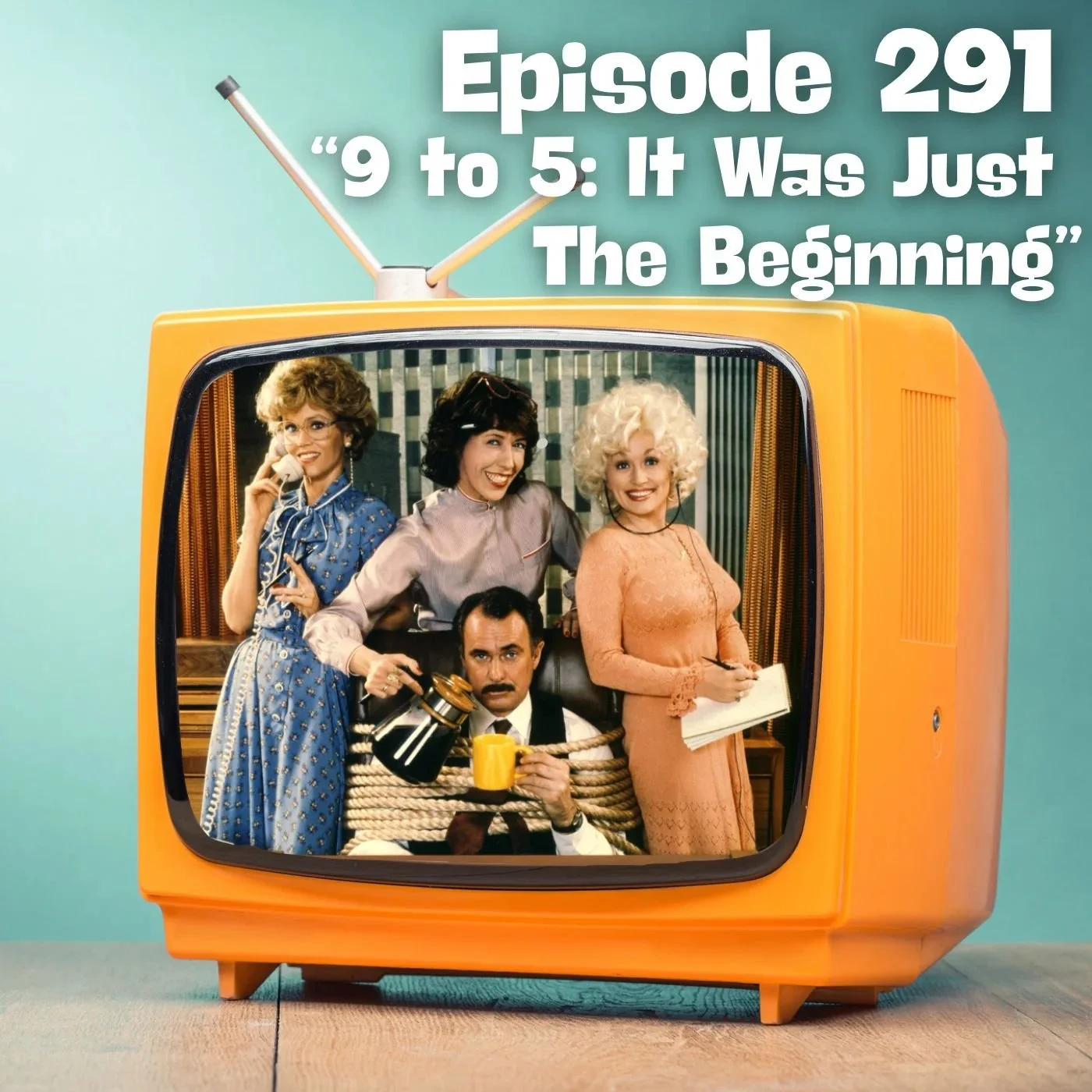
Kristin Nilsen 0:00
Welcome to the Pop Culture Preservation Society, the podcast for people born in the big wheel generation who found their movie times in the pages of the local newspaper.
Carolyn Cochrane 0:10
We believe our Gen X childhoods gave us unforgettable songs, stories, characters, and images, and if we don't talk about them, they'll disappear like Marshall, Will, and Holly on a routine expedition,
Michelle Newman 0:22
and today we're finally getting to the movie Nine to Five, a revolutionary, rebellious, and brazenly political movie that had the whole world laughing while also giving birth to a new vocabulary word: sexual harassment.
Carolyn Cochrane 0:38
I'm Carolyn.
Kristin Nilsen 0:39
I'm Kristen.
Michelle Newman 0:40
And I'm Michelle, and we are your pop culture preservationists.
Kristin Nilsen 0:44
Everything you need to know about the 1980 movie Nine to Five is contained in its theme song, famously written by Dolly Parton while she clicked her long nails together to simulate the sound of typing on a typewriter. So let's just start with the verse. Let's start this whole episode with verse one of the song Nine to Five, which, in my humble opinion, has some of the best, most rhythmic lyrics ever written. Here we go with spoken word, right? We love our spoken word performance. I tumble out of bed and I stumble to the kitchen. I pour myself a cup of ambition. I yawn and stretch and I try to come to life. I jump in the shower and the blood starts pumping. Out on the street, the traffic starts jumping, and this is the most important line. And folks like me on the job from nine to five. So she's tired, she's beleaguered, but she's ultimately working class. She's
Michelle Newman 1:39
ambitious.
Kristin Nilsen 1:39
She's ambitious. She wants that in there. I mean, you get so
Michelle Newman 1:43
much in there. There's so much in there,
Kristin Nilsen 1:45
and the and the thing that I like about folks like me on the job from nine to five, she is establishing a collective.
Michelle Newman 1:53
Oh yeah,
Kristin Nilsen 1:54
like I'm talking to you guys. We are the working class people. Okay, so let's move on to the chorus, the first chorus, and the song is mostly chorus. Working nine to five, what a way to make a living! Barely getting by. It's all taking and no giving. They just use your mind and they never give you credit. It's enough to drive you crazy if you let it. Nine to five for service and devotion. You would think I would deserve a fair promotion. I want to move ahead, but the boss won't seem to let me, I swear. Sometimes that man is out to get me, and here we have the theme of our movie.
Michelle Newman 2:28
It's so smart. That song is so smart, and to think she wrote it basically sitting in a car on set, like she was just sitting there, like oh, I yeah, that was sort of one of her stipulations, right? If I'm going to be in this movie, I get to write and sing. I get to write the song. It's so brilliantly written and so smart. I just, I'm just in awe of her song. Totally, the wordplay
Carolyn Cochrane 2:53
and establishing, like you said, the entire movie in those what maybe like seven lines. Like we know what we're getting into right away, and I was thinking, you know, I would belt this song out the top of my lungs in the '80s. I knew every word, but I don't think at that time I really understood like what exactly it was saying. Like I could say the whole thing, but it wasn't until you know you become an adult and you actually live this life, and really now as we revisit the the movie and the song, like golly gee, was she smart? And that was like her gift as was to send these messages to us through great lyrics and her great fun voice, and she didn't have to hit us over the head with anything. But yet, the whole movie right here, and she
Kristin Nilsen 3:38
says it so plainly too. I mean, she has some great. She has some great. What's the word I'm looking for? Some great play with tumble out of bed stumble to the kitchen. Pour myself a cup of ambition. Yes, pouring myself a cup of ambition. That's brilliant. But the rest of it is just very plainly said. She doesn't have to get too clever, or she just she needs people to understand what she's saying and what you're saying, Carolyn, about how we didn't really understand what we were singing about-that will be, I think, the theme of our whole episode today. Can I
Michelle Newman 4:07
just interject my very favorite? I think the whole thing is so smart, but always my favorite part. And to your point, Carolyn, I don't-I never really got this, but as an adult, how brilliant is the? You're just a step on the boss man's ladder, but you've got dreams he'll never take away. How brilliant is your? I did too.
Kristin Nilsen 4:27
I know you. I'm
Michelle Newman 4:28
wearing like a thicker bra too, which was smart today. You're just a step on the boss man's ladder. Is I mean the other part too, but just that he's the one who gets to climb the ladder and use you. I mean, I know everyone right now is like, thank you, Michelle, for for plain speaking that to us. But but it's just so smart. Oh, so smart. And the next
Carolyn Cochrane 4:50
oh, go ahead,
Kristin Nilsen 4:51
go ahead. No, you go ahead, Carolyn.
Carolyn Cochrane 4:52
I was just gonna say the next three lines are the ones that I love because she kind of follows this whole motif of boats, and you know we're all in this boat together. Waiting for the day our ship will come in. We're in a boat, but we want our ship, and the tide's gonna turn. You know, so we're still water. It's all gonna roll your way. I just so good when though.
Michelle Newman 5:11
When I wonder why we're still waiting.
Kristin Nilsen 5:17
So the movie Nine to Five has always been about one thing: discrimination of women in the workplace, but as time goes on, just like Carolyn said, I have a much bigger appreciation for how truly radical it was, how purely political, how brazenly it called out the problem. And I think if we go back to our first viewing of the movie Nine to Five, and I'm talking to you listeners in December of 1980, we first and foremost remember it being funny. Did we, again, listeners, Michelle, Carolyn, did we truly understand, even in subsequent viewings throughout the years, what this movie was doing? What were your first impressions of the movie when you saw it? I mean, when you were a kid, what were your first impressions? And I
Michelle Newman 6:01
think yes. Did I understand yes? Even as a fifth grader, yes, but mostly no. I mean, first of all, I loved this movie, even as you know, an 11-year-old. I loved this movie. I knew for sure that it was about getting back at a slimy boss, right? And I knew the ladies were underappreciated. I got that as a fifth grader, but did I know all the ERA stuff that was actually going on in the 70s, or even at that time, the background, the laws, all that stuff? No, absolutely not. But even as a fifth grader in 1980, when I say I knew it was about the slimy boss, they were underappreciated because I knew that that was the culture. Like even as a fifth grader, I knew that that's what happens when you go to work and you're a woman.
Carolyn Cochrane 6:52
Yes, I totally agree with everything you said, Michelle. I think watching it, it was just a funny take on reality. Like I just thought, this is how it's going to be. You know, maybe not all bosses will be this way, but that was just kind of what the workplace was going to be like out there. Never thinking that this was made as a way to perhaps change that. This was more of a reflection, but not as a kind of a means to changing anything. So that was all really like I was last year, last week's years old, kind of when I was discovering really all that went into the making of this movie. It was also like one of those HBO movies, like when we finally got cable. It was one of those things that would be on TV. So I, I think I probably watched it with my parents right next to me. But we were all just laughing. Like my mom wasn't pausing and saying, "Yeah, and gosh darn it, things need to change. We just were, you know, enjoying the holiday,
Kristin Nilsen 7:47
Carolyn. Yes, yes, exactly. So, and I had special circumstance. Well, first, I will say, I felt like I was being introduced to the topic with the movie Nine to Five. This was something I knew nothing about, even with free to be you and me and stuff like that. I didn't understand that she was trying to make things equal. I thought she was just telling me that things were equal. I didn't, and I didn't have the observational powers to see it otherwise. And so I had special circumstances in which I was going to see this movie with my cool aunt because my cool aunt's bestie was the assistant to the director on Nine to Five, so we were going to see the movie with with with special feelings, right? And because of the special feelings, my cool aunt Natalie was was telling us more about what the movie was about, about workplace discrimination and how they were trying to expose to the world what what terrible things bosses could do because you are a woman. So my eyes were being opened. That being said, I still did not understand the impact or the gravity of it or the or I was just like, yay! They're telling us how how it is for women, but not it's not going to be like that anymore because of the movie, right? I just was a little bit naive about it. It's like we didn't
Michelle Newman 9:08
understand the purpose of it almost. We got it. We got the commentary, but we didn't understand maybe the purpose or the impact they were hoping to have with it.
Kristin Nilsen 9:18
And my mom, I'm sure your moms didn't either. My mom never had a conversation with me. I would have been 12 years old, so I'm old enough to handle a conversation like that. My mom never had a conversation with me about what it meant. My she never informed me about how difficult it was for her. I know stories now. Everybody's got stories. Everyone, especially our moms, all have stories. But everyone just talked about after the movie. It was only about how good it was and how funny it was. We went, so I went into it knowing that there was a purpose. I came out of it going, "It's so funny! It's so funny! So let's talk about the origin story, as Carolyn intimated. There's so much about what happened before the movie. Was made, so it was created first and foremost by Jane Fonda, and it was based on real people, and a real labor movement formed by a group of secretaries in Boston. We've all seen Mad Men, so we know what the secretarial pool looks like, right? It was, I was going to say it was predominantly women. No, it wasn't predominantly women. It was all women, and I was going to say, and predominantly men in the management world. No, no, not predominantly all. So the secretarial pool was all women in skirts and heels, and again, most of not most bosses. All of the bosses were men, and this leads to some pretty profound problems. So this group of secretaries in Boston in the 70s band together to discuss these problems. Sexual harassment was not a word that existed when we went into nine to five. That was not a word. You guys, can you imagine living in a world like think? Just think back to a time when we didn't have that word, and I remember being given that word. And I'm pretty sure. I mean I could be making this up, but I feel like it was in the aftermath of the movie where my aunt was like, and that's called sexual harassment, and now we have a word. So it was sexual harassment, lack of respect, unequal pay, no protections during pregnancy, lack of upward mobility. This group in Boston was trying to make people aware of these problems and fight for protections, and the name of this group was Nine to Five, based on the hours worked by most clerical workers. So pre Nine to Five, the organization, Jane Fonda was an activist primarily protesting the Vietnam War. Everybody remembers Hanoi Jane, right? Hanoi Jane went to Vietnam, and Jane befriended another activist, another Vietnam War activist named Karen Nussbaum. They were activist besties, and Jane would even-I can't even believe this-Jane would have sleepovers at caron's house, and Karen is a totally normal human, like with a shitty apartment and a bunch of roommates, and and Jane would come over and like sleep on their couch or something. I mean, just can you imagine if your roommate brought home Jane Fonda? Okay. So anyway, after the Vietnam War ended, both Karen and Jane go back to their day jobs. Jane as a famous movie star, and Karen as a clerical worker. This is where butt pinching, coffee getting, revenge firings were everyday experiences, and again, as we all saw on Mad Men, it's so cringy, you guys watching Mad Men. It's I actually have trouble watching it, but secretarial work was one of the only fields open to working class women, so millions of women, millions and millions upon millions of women had no choice but to put up with the conditions that were not just demoralizing and you know potentially dangerous, but also kept them from moving up in their companies and getting better pay. And when Jane became aware of Karen's work with Nine to Five, she said, "How can I help? And this is your origin story. So the thing that is interesting is that Jane Fonda. I mean, obviously we know she said, "Okay, I can make a movie. Do you want to make a movie? Is would that be helpful? Well, and it's just
Michelle Newman 13:11
can I just say it's just another of a long list of examples of Jane Fonda making a difference, however she can, right? I mean, she knew where she had pull and power, and so so she so intentionally set out to help them make a difference. And she's like, "Hey, I know what I could do. I know a way I could get this out there, you know, to the masses, to the general public. It's just so yeah, so not just the
Kristin Nilsen 13:38
powers that be, but the general public to the 12 year olds in Minnesota, she was going to get this information to them, and the thing that I find so interesting is that Jane Fonda decided to turn this horrible problem that we were dealing with into a comedy. I think
Michelle Newman 13:54
that's so smart, though. I think that, like, I feel like because making light of it is almost like clickbait, right? It's like you draw in more of the opponents because it's this comedy, ha ha ha! And then when they're in there, like we're gonna go watch this comedy about secretaries, you hit them in the face with
Kristin Nilsen 14:13
it. Yeah,
Michelle Newman 14:14
right. Right. So it is. It's like I thought that was. I think it's really smart. I know it's almost. It's baffling. Boffling. I'm British. It's baffling. It's baffling with at the outset when you're like a comedy. This isn't a comedy, but I also feel like there's a method to Jane's madness. Of
Carolyn Cochrane 14:31
course, and I think too. I've I've shared this a few times, but you know, comedy is some of the easiest ways to say the truth, and when you find yourself laughing at it, and I've I have this line I always say, my dad would tell me that the truest things are said in jest, because you can kind of make those digs. And look right now at our comedians, our Jimmy Kimmels, our Stephen Colberts, who are you know putting the truth in our faces through that through that comedy.
Michelle Newman 14:59
It's. Saying it's funny because it's true because it's true. And Jane
Kristin Nilsen 15:03
Fonda has said, she's like, I honestly just didn't think anyone would watch it if it were a drama, and women already had difficulty getting people to listen to them. She didn't know, especially how she would get men to come to the movie. And as we know, we can't move forward with only women working for women's rights, we need men and women to work together for work for women's rights and workers' rights, for that matter too. And she was like, I didn't know how to get men to come to the movie, and so this is what she decided that we're gonna make this funny, we're gonna make it palatable, but we're going to make it utterly real, freakishly real. And
Carolyn Cochrane 15:41
can I ask? I don't. She didn't say this outright. I don't think, but there has to be something about getting us young girls to come to see this movie because we are that next generation who's going to carry that torch. And maybe even if we didn't know that we were absorbing some of this information, it it was in us. Like we're gonna be in the workforce a few years from now. We're gonna recognize that. Oh, that was that scene in Nine to Five, and were we not also maybe somehow part of that demographic, and especially the song, that we were gonna be the next people to be encountering this, and how were we going to deal with it? I think that was genius in the comedy aspect of it.
Kristin Nilsen 16:24
And she, because it was not rated R, and it didn't have anything clandestine in it. It did. It was a. I mean, assuming it was rated PG, but it was a family history. We were all going to see it. So even though I've never heard her say that, it has to be a part of the of the decision making because they could have easily made that a rated R movie and they didn't. Oh,
Carolyn Cochrane 16:45
for sure, and made it a little more salacious and everything.
Kristin Nilsen 16:48
Yeah. So then the next hurdle was how does Jane Fonda go to these studios and pitch this thing? Because who is she pitching to? All men, studio heads were not
Michelle Newman 17:02
of course
Kristin Nilsen 17:02
how so she had to make it palatable to them too. That's another reason for making it a comedy. But here was the thing that got her across the finish line, and that is that there was and this was this she was given this piece of advice from Karen Nussbaum, I believe, the nine to five organizer. She said, "You need to remind them that you have a ready-made audience because there are 20 million clerical workers in the United States at that time when they were pitching. That blew me
Carolyn Cochrane 17:29
away. Some of those stats of how many
Kristin Nilsen 17:31
million, how many? If you're a clerical worker and there's a movie about clerical workers, you're going to that movie.
Michelle Newman 17:37
Well, and and let's add on the people who are starring in it, right? So that's right. Yeah, of course. So you've got this perfect cocktail of a movie and an audience.
Kristin Nilsen 17:46
So one in three women who were in the workplace at that time were office workers working as secretaries or in a secretarial pool or as clerical workers. And one of our sources for this for this episode was a Planet Money podcast about Dolly Parton, and I just thought this was very astute. They said, "When you say working class, you probably think of a man in a hard hat, but the most typical worker in America, especially at that time, was a woman at a keyboard. That was the working class, but nobody was talking about it or being real about it. Right? Most working and most working women, not just clerical workers, but most working women in 1980 had experienced some kind of discrimination or harassment or just inappropriateness or discomfort in the workplace. Like let's just say that was 99% of the women. So they're handing when they're going in to pitch this movie, they're like, everybody has experienced this. This is the height of relatable. This is the height of relatable.
Michelle Newman 18:48
Like I said earlier, then when you add in Jane Fonda, Dolly Parton, Lily Tomlin, it makes this just delicious, right? Especially for those 20 million workers. And what I think is so interesting is that Jane Fonda's thinking? Okay, she's got this this working script, and she's like, okay, so I need three. You know, I need to represent three. So she she thinks who I want to be in the movie, obviously. Who else? Well, she loves Lily Tomlin, doesn't know Lily Tomlin, but at the time, Lily Tomlin was big stuff. You guys, I mean, let's not forget all you know, the laughing and all this kind of stuff that she had done, and all the characters that everybody already loved. But then the thing that just cracks me up is then almost doing a 180. She's like, "Hmm, you know who's really big stuff right now? Not in the acting field, but like you know, in the music world, is Dolly Parton, and all Jane knows about Dolly Parton is just how sweet she seems and how relatable. Never done, never been an actress. This was Dolly Parton's very first acting. You know, nobody
Kristin Nilsen 19:54
considered her for anything like this before. No, but Jane did,
Michelle Newman 19:57
and what I just love about this. Is that, I mean, I love Lily Tomlin in it. Let's just say that, and we're going to talk a little bit more later about Lilly more in the movie and her her thoughts and feelings about the movie. But I right now just want to focus on Dolly and on Dora Lee because she goes, she approaches Dolly Parton. Do you want to be in this big movie with me, Jane Fonda, and Lily Tomlin, Dolly Parton, as someone who's never had a role, doesn't know anything about directors and working with all the people and scripts. Goes okay, like yeah. Just the confidence that woman had was just so. And you guys, just like she did in all her other movies, she knocks it out of the park. As a child, as an 11 and a half year old, Dora Lee was my favorite, and it had everything to do with just her sweet mannerisms, her voice, her hilarity, the way she delivers her lines. I mean, her comedic timing is incredible. Yeah, so it's just so bizarre that we've got these two really big celebrities, actors, stars in their own right, but then you've got Dolly Parton, and I just think it's so-it's almost like a contradiction in the best, most delightful way. And she says, "Oh, we're totally different. Like Jane was very political. All I knew about Jane, she says, other than her obviously her acting roles, is how much of an activist she was and how politically outspoken she was. And Dolly says, and this is something we just talked about, you guys, in our Dolly Parton episode. Dolly says, I definitely have my political beliefs, and I'm very, I feel very strongly about them. But that's not me. I'm not ever gonna go out and like wear them on a shirt. She's that. That's sort of paraphrasing what Carolyn had said in our Dolly Parton episode. Dolly's like, but at the same time, we all meshed. We couldn't. The three of us couldn't be more different. Right. But yet, we all formed this sisterhood, which be is so evident in the movie, right? The chemistry is
Kristin Nilsen 22:06
crazy. The chemistry is crazy good, and I think this is such a good story too. This is to the credit of Jane Fonda's instincts because, like you said, she goes to Lily Tomlin based on the work she knows of Lily Tomlin. Dolly Parton has never displayed any acting ability? She's never been in anything. She's she just Jane Fonda just had an instinct, and she said she was listening to the radio and and Dolly's song "Two Doors Down Here. Oh, that's right. I love the song. Two doors down. I'm having a
Carolyn Cochrane 22:37
party, and she thought to
Kristin Nilsen 22:38
herself as she's listening to this song, she thinks to herself, "Well, she's never been in a movie, but I bet she could be herself in a movie. Exactly, and that was her success, right? Because she was able to be so freakishly authentic. She was not trying too hard to act, which is what so many people try to do. She was like, "I'm just gonna go be Dolly Parton, and it worked. It totally, totally worked.
Carolyn Cochrane 23:01
I just wanted to say, for me as a you know young girl watching it, I don't know that I knew this at the time, but I had an impression of what you know. Let's just say, like a bimbo would be, like a dumb blonde with big boobs, only got the job because that was you know how they kind of portrayed Lonnie Anderson, and but yet they had a way of she looks like she's that part. But then you watch the movie and you see just how much she stands up for herself, just how smart she is. And it was probably the first time as a young person that I saw, huh? Look at that dumb blonde. She's not so dumb after all. Totally, they humanized
Kristin Nilsen 23:41
her, right? They humanized her, and they let you see all parts of her, which is never what you think. It's just never what you think. Of course
Carolyn Cochrane 23:47
not.
Kristin Nilsen 23:47
And I also have to wonder when Dolly was offered this this job. Just can you imagine for a minute? Everybody, just think about through her what 60 years, 70 years of being in the music industry, can you imagine how much harassment Dolly Parton saw in her lifetime? Well,
Michelle Newman 24:07
yes. Well, was it Mike Douglas who was the the interview, the interviewer in the documentary we watched that asks her, "Were you always, let's just say, so like well endowed? Like the question as she's sitting on the couch. He basically asks her, "When did your boobs grow?
Kristin Nilsen 24:24
Yeah, tell me your boots. He's talking about your boobs. Were you
Michelle Newman 24:27
always this? Let's just say, and he's like, tries to act like, well, I don't know how to say this nicely. Or Murph Griffin. No, it was Murph Griffin. It was Murph Griffin, I believe. Yeah, and he says, "Were you always this well and down? And she just like she always did. She's like, well, yeah. I mean, she just takes it. She just
Kristin Nilsen 24:44
yep. She,
Michelle Newman 24:44
but that he asked that question is disgusting. That
Kristin Nilsen 24:48
he thinks he has the right to talk about a woman's body. Yeah. I mean, just think about how many people did she have to fight off? How many desks did she get chased around? How many people? Propositioned her and offered her a record contract. How many people said we won't give you this unless you give me this? Like how I just I shudder to think of what what it must have been like for her, especially with you know walking around with those boobs is not easy. People that people make well just the physicality of it. The physicality, yeah. Well, there's that. Yeah, yeah, there's that. But just that people want to make assumptions about you based on what attributes you have, and that was not an easy road to hoe. And so I wonder if there was a part of her like, hell yeah, let's put this out there. Let's show people what it's really like. Yeah,
Michelle Newman 25:37
yeah.
Kristin Nilsen 25:38
So before we revisit the plot, can we please just talk for a second about the nostalgia of the set? We're going to an office in 1980, people, and what does that look like?
Michelle Newman 25:50
Oh, I mean the typewriters, and what I love too is the typewriter covers. Oh, yes! Before last, everybody pulls out. All I was thinking is how much valuable real estate that typewriter cover took up in their drawers. Like, think of all the like purses and things you could put in there. Your lunch, they all take out their typewriter, their dust covers.
Carolyn Cochrane 26:12
And that opening credit scene where you're seeing all of these people going to work and getting to work, and you're seeing a lot of their feet, and so yes, you're seeing those heels, and pantyhose, and all that stuff. And you're seeing people like running in them, and you're thinking, "Ouch! Like, how are you not like tripping? And you know, I think you pointed out, Kristen, earlier when we were getting ready for this episode. Like, at some point in time, someone was like, "Hell no! I'm gonna put on my Reeboks and I'll carry my shoes in you know up my purse or a tote bag, but that hadn't happened yet. We haven't owned that. We thought we had walking shoes working
Kristin Nilsen 26:51
your tennies and changing your shoes. Exactly. Walking down the hot street in your in your yeah running
Carolyn Cochrane 26:57
for the bus. Yeah, and the hoosker do moment that I had, that I was like, oh my gosh! I'll take a little aside here. Some of my summer jobs during college were at my dad's work, which was Texaco, which was a lot like this. So I was kind of like a floater, they called me. And so when one of those clerical ladies would maybe take a vacation, I would be sitting in their seat and having to answer the phone and play with that. What were those called? Select. It was an IBM typewriter. So those electric typewriters were fancy because they had the little Selectra. Yeah, because they had that ball in the middle. Like they didn't have keys. They had that ball that turned. It was like mini computer.
Kristin Nilsen 27:34
Uh huh.
Carolyn Cochrane 27:34
But do you remember there was this thing that held the phone on your shoulder? Yes. This shoulder contraption. So you could have both of your hands free while you were still talking on the phone. And I remember trying to get that shoulder thing on and talk without it like slipping off my shoulder. No, I think I had weird shoulders.
Michelle Newman 27:52
You still had to tip your head. Yeah, you did, but you had three of it with
Carolyn Cochrane 27:55
your hands. So instead of having a plastic
Kristin Nilsen 27:58
wedge,
Speaker 1 27:59
yes,
Kristin Nilsen 28:00
that was on your on the receiver.
Carolyn Cochrane 28:02
Do you remember?
Kristin Nilsen 28:02
I watched this. This was an interesting experience for me. I watched this with a friend who was a lot younger than me. She's solidly millennial, and so when she saw that scene, she didn't say, "Oh, look at all the typewriters, like we did. She went, "Oh my God, there are no computers, and that that made me look at it through a completely different lens. It did look completely different. You walk into an office today, and there's something upright on everybody's desk, and there was nothing upright on their desk. The other thing that made that gave me a lot of nostalgia, which I wish we still had, was punching in. You grab your card and you punch it in the machine, and then you put it in the slot.
Carolyn Cochrane 28:42
But also, that reminded me when I worked at Texaco. You started to look at your watch at like a little bit before five. Everyone stood up at maybe like three minutes till, so you could see everybody's head above the you know cubicles. But you waited for the man to walk out of his office, and then when he left to go the elevator, then we all filed out like nobody even thought about. Oh, you know, I've got to. I got to pick up my kids. I'm going to leave a few minutes early. Like that didn't even dawn on you. And this was everybody, and it was just everyone's heads. You were just. You weren't anybody in those scenarios. You were just a little minion, a little machine. How about that massive Xerox machine too? When Jane Fonda is the nice of a room, I remember yes when there were like several people. That was their job too. Was like the Xeroxing that and there's another sound when they're like going in those little sections. These are office
Kristin Nilsen 29:38
sounds. Okay, so now let's let's revisit our plot. I'm just going to walk you through this so you know what we're talking about as we talk about the rest of the movie. So Nine to Five is the story of three office workers who have all suffered at the hands of an insufferable pig of a boss, played so brilliantly, so great, and so perfectly by Dabney Coleman. And I can't remember what his name is, so I'm going to call him Dabney Coleman. Mr.
Michelle Newman 30:00
Hart,
Carolyn Cochrane 30:01
yeah, mr. Hart. mr. When she puts his name, it's like Franklin something heart. Oh, and Lily Tomlin puts her name over it. She calls him. I just call him mr. Fart. mr. Fart. Yeah, I love that.
Kristin Nilsen 30:11
So when one of these women accidentally puts rat poison in his coffee, the coffee that he incessantly demands from people whose job description does not include getting coffee? So instead of somebody, one of the women accidentally puts rat poison instead of skinny and sweet in his coffee because the boxes look just the same. He ends up in the hospital, but unfortunately, he comes back even stronger, and now he's pissed and he's out for revenge, and he's threatening to go to the police and accuse these three women of attempted murder with the rat poison. That's when things get a little out of hand. He's tied up with an extra long phone cord and held hostage in his own home until the three women can get the evidence they need to expose his fraud against the company. This is their backstop to his threat to report them to the police for attempted murder. So while they keep him tied up in his home, the three women run the office much better than he did, of course, because they institute all sorts of programs to support the clerical staff. They have flex time, job sharing, child care, and the company shows massive improvements in productivity, in employee retention, and morale. This is the story of Nine to Five. So let's start with our main characters. In this watching, for the first time, I picked up on the fact that Jane Fonda, Lily Tomlin, and Dolly Parton each represented one archetype of discrimination. Let's just-they were each talking about the different forms of mistreatment. So let's start with Lily. What was and what was Lily Tomlin's name? I don't know. Her name's Violet.
Michelle Newman 31:50
Violet. Violet is. She's a widow. She has like teenage kids. You can tell from the first 10 minutes of the movie that Violet runs that office. Like she is sharp, and you can tell everybody respects her. She even has this great rapport with like the security guard. Everybody loves Violet and respects her, except mr. Hart. It's the absolute classic illustration of she's her head has hit the glass ceiling, like yes, absolutely. So this is this is basically her stereotype, right? Or her, you know, what they're trying to show, the discrimination they're trying to show is that she's, you know, and spoiler alert, but she's not going to get the promotion that she's way overdue for and that she deserves overqualified
Kristin Nilsen 32:39
for. Overqualified, the man is
Michelle Newman 32:41
going to get it. Who's way underqualified. Also, she's the one who has basically come up with all the ideas that the men are getting the credit for. So this is the this is the absolute you know discrimination against the women in the 70s who basically ran the show, and they the glass it's the it's the absolute typical glass ceiling. There can't get any higher, so that's I feel like that's Violet's. That's the determination they are. They are, and he steals her
Kristin Nilsen 33:14
ideas. He passes them off as his own. He asks her to get him coffee as if she's his secretary, but she's not. She trained him. He just leapfrogs over her. She continues to be the person who trains all of these men because she's so good at her job. Right. Well, and she doesn't get credit for it. She's
Carolyn Cochrane 33:30
kind of stuck too because she's a widow. She so she can't take the chance of asking for the raise or the promotion and threatening that she's going to leave because she can't afford to leave. So I I loved the way they showed how you were stuck in so many ways, not just within the corporation and climbing this ladder, but you didn't have the ability to really leave and find something else because you're a widow and you can't you have to yes and you have children to
Kristin Nilsen 33:56
feed yeah mr.
Michelle Newman 33:57
Hart even there's this great bit of dialog where when she's just pissed that she was overlooked yet again for the promotion that she deserves and the underqualified man gets it, he tries to soften it by because he's he's also trying to be very like we're pals. No, you're my right arm. You're my right hand man. I appreciate you. And he says I know, but he's got a family. He's got a family to meet. Yes, yes. And she's like, I'm sorry. Who do you think feeds my family? I'm a widow. And he's just like, well, you know, he like brushes it off. Like that doesn't matter. He has no
Kristin Nilsen 34:33
answer for that whatsoever. Jane Fonda is the newly divorced woman whose husband left her for the secretary. A tale as old as time. She has no job experience, like like Carolyn said, because she's been a housewife for her whole adult life, and being a wife doesn't get you very far on a resume. So her choices are limited. She also doesn't have a lot of a lot of like Lily Tomlin. She's kind of stuck. She needs this job, and she doesn't have any skills. So. And her housewife skills are not super lucrative. She has very little power or agency now that her husband has dumped her. She's never worked, but now she needs the money, and she's vulnerable. And I feel like Jane Fonda was all of the moms in the 80s. Yeah,
Michelle Newman 35:16
yeah. It's also very telling. I think the different the the way. that mr. Hart, the different ways mr. Hart treats Violet and Judy. So, like Violet, he's he's almost very like, come here, like let's let me just tell you why. Like we're in cahoots, we're in this together. He gets stern with her, but with Judy, Jane Fonda's character-he just screams. I mean, he rips her a new one. He screams and berates and belittles her, and it's disgusting the way that he treats her like she's gum on his shoe. You know, right? And so, wow, that's a big difference too to see to see the different way that he's kind of wielding his power over this newbie who he feels like a you don't matter yeah
Kristin Nilsen 36:04
yeah and I remember there was a point where I got yelled at like that by a boss and I and I knew in that moment that I was nobody and because I felt that way and I knew he was not like nobody should speak to you to that way nobody and he did it in front of the staff he screamed at me in front of the staff, and I was only 21 years old, and I'm like, Kristen, you have to go say something, and I was so terrified. I was so terrified. I would have cried. Yeah, I was working so hard not to cry. I didn't cry, but it was everything I took not to cry. And I went into his office and I said, you really disrespected me out there, and I did not deserve that, and that was not okay. We didn't say not okay in those days. I don't know how I said not unacceptable. Unacceptable.
Michelle Newman 36:46
I just have to laugh because I think I think hearing you say that and how I said I would cry. I feel like we've touched on this before. I just think about Mary Richards, how when she tries to be really big and go say something to mr. Grant, she's dying to cry. And again, that is why I am a Mary, and you know what? I had a
Carolyn Cochrane 37:02
very similar experience to you, Kristen. Except as I'm reflecting on it right now, it was a woman boss. So this would be late '80s, same thing in front of people. And I wonder, as I'm saying this out loud, oh, it was so traumatic. It still makes me sick to my stomach. There's a betrayal feeling of when it's like someone on your own side, and then you feel like for those women who did finally maybe rise a little bit in the on the corporate ladder, they probably felt like they had to play this game too. Like they couldn't go in there and be the oh, it's a you know they couldn't maybe they had to still act like maybe the jerky other bosses. Yes, you had to play that game. Right, you were not there
Kristin Nilsen 37:47
for the women.
Carolyn Cochrane 37:48
It was still a consequence of all the stuff we're talking about. Even though she was a woman and had risen, she still was trying to find her place. I think and fit in, and the fact that she did it so publicly was to me also something else. It was as much about her making a statement about her
Kristin Nilsen 38:08
power as for power because my
Carolyn Cochrane 38:09
thing was silly, but it was so condescending. It was one of these. I'm just going to say it now. We can cut this out if we don't want to. I won't say names, but I worked in a corporate communications department and I wrote articles and stuff. And she, for like the employee magazine and stuff, and she threw this article like on my desk, and she said, "This is worse than a high school journalism class. Like it was so belittling and so like just kind of threw this thing at me. And she could have called me into her office. She could have done a multitude of things, but anyway, it's just interesting to think what was that really about? It wasn't about maybe I had some typos and could have rewritten some sentences to be edited more succinctly. This was about her and kind of making a statement to the rest of showing the
Kristin Nilsen 38:55
office that she had a penis.
Carolyn Cochrane 38:58
Exactly, essentially, that's exactly what it was. Yes,
Kristin Nilsen 39:01
yeah, and you and I am the boss, and it's and I'm a woman, and people may not listen to me because I'm a woman. So I better scare the shit out of these people and show them that I am a dick. And that's what, in
Michelle Newman 39:12
her defense, and I don't want to defend her because that was really mean. But also, that's you said late '80s. That's so telling because that tells now she could have just been no, but it's such a. I feel like it's such an illustration of that's how these women who finally got maybe the job they deserved. That's so sad because they still felt like, well, who am I going to throw under the bus today in a really loud and a very obvious way? I think to prove that I'm
Kristin Nilsen 39:40
strong enough to have this place, right? I think this is the
Carolyn Cochrane 39:42
first time, even as I'm just talking through this right now with you all, that I see it through those eyes. Like forever, she has been this b i t c h that was awful and mean, and sometimes I'd look her up to see what are you doing now? But now I'm like. Have this sense of empathy that I maybe wouldn't have had as I'm processing this. Like, okay, so she was one of those first people, but you're not going to go and things are going to change over. Yes, and so anyway, yes. So there's a little forgiveness going on in my.
Kristin Nilsen 40:16
I I think, and that's something that you can't know when you're in it. You just can't know, and I'm not even sure if she if it would be a conscious decision to act like a man. But that is now in retrospect, we can look and see how how you know the Sheryl Sandbergs of the world were trying to act like men in order to be in the world of men. We can't bring our you know whatever you get. We could we could this could be a whole episode in and of itself. But thank you for letting me have that
Carolyn Cochrane 40:42
kind of therapy real time because I really do feel like oh I I kind of get it from a different angle now.
Kristin Nilsen 40:49
Okay, so that's Judy and that's Violet and then Carolyn, tell us the last archetype. Our our dear dear Dora Lee played by Dolly Parton.
Carolyn Cochrane 40:58
Yes, and Dora Lee kind of sounds like Dolly, doesn't it? Yeah. So Dolly is a stereotype of a secretary that you think maybe is all air up top. She's this blonde woman. She wear she has very large boobs. She dresses what some people might have said at the time, kind of suggestively. She's not covering up the cleavage. She's leaning into that. And you and we all, as watchers, as well as the whole staff,
Kristin Nilsen 41:22
and truthfully, I do have to stop you. Not really. It's just that it's hard to cover all that up. Well, there's that too. She does
Michelle Newman 41:28
wear sweaters and stuff. She doesn't wear it. I think
Carolyn Cochrane 41:32
I want to almost give her the credit that she that she's due. Like I think that they were trying to portray to not only to the audience but to the rest of the staff who thought for sure she was having an affair with the boss, like they're looking at what they're all wearing, and they're-I would think this is how I looked at it. She wasn't doing,
Kristin Nilsen 41:51
but put those same outfits on the on the skinny people with no boobs. They're the same, but they
Carolyn Cochrane 41:56
wouldn't probably have worn them because they were, you know. I mean, I feel like she did
Kristin Nilsen 42:00
have like the A-line skirts and the sweaters. There's just the one day where she wears the frilly little white dress, but otherwise she's wearing the same exact thing.
Carolyn Cochrane 42:09
Okay, well maybe we'll take all of that out. No, I think it's important. Well, okay, yes. Well, no, I mean we'll take out my my perspective, but I thought that they that the they were trying to make us think she was the stereotype, and yet she wasn't. If that makes sense, like you could wear that those clothes and not be the boss's, you know, side piece. But
Kristin Nilsen 42:32
yeah, but let's put the let's put the emphasis on Dabney Coleman. Let's like let's take her archetype and look at Dabney Coleman instead of what she's wearing, Dabney Coleman chases her. He tricks her. He begs her. He throws her to the ground and throws himself on top of her, and he is he's endangering her. And she's like, "I'm a married woman. I'm a married woman. He lets the office think that they're sleeping together. He wants the office to think that they're sleeping together, and this makes her a pariah among her colleagues, and she doesn't even know why. She's like, "Why does everyone hate me?
Michelle Newman 43:08
I think it's very important that something that I remember feeling at age 11 and a half is not get obviously the boobs, right? We know that, right? But her whole, I felt like her outfits, but just from the very beginning. I mean, she tells him, "mr. Hart, I'm a married man immediately. And like, what are you doing? I felt like from the beginning she isn't putting that out there at all. No, he though is immediately when he pushes the pencils, like the first time you see the first scene with her, he pushes the pencils off the desk, and we get the shot looking down. She has to go down to the floor to pick up
Kristin Nilsen 43:47
the pencils,
Michelle Newman 43:47
and and as you would do in the 80s, you would just have to laugh it off, or you were going to probably get fired, right? Yeah,
Kristin Nilsen 43:53
she knows he's looking down her. I
Michelle Newman 43:54
love, I love that Dora Lee is. She's just this is who this is my body right like this is who I am but I'm not trying to be overly sexual right out outwardly I should say outwardly sexual you know this is just unfortunate and what's really interesting is let's go all the way back to the intention of this movie and I mean Jane Fonda, or not Jane Fonda, the first writer of the original writer, Patricia Resnick of the movie. She actually went to an office to work. Yeah, she met with a woman who was a secretary and just started crying over lunch with Patricia Resnick and saying, "None of the other, you know, ladies like me because they think I'm sleeping with the boss and I'm not, and it is like there's nothing I can do to you know change their minds. And Patricia
Kristin Nilsen 44:51
also thought she was sleeping with the boss, which just shows you how pervasive those rumors can be, especially if somebody is well endowed or looks a. Certain way or something like that.
Carolyn Cochrane 45:01
At that point in time, when I first saw the movie, I'm not talking about now that I am have evolved. I feel like that's exactly what I thought going into that movie, and that there were these women that were, I mean, floozies. I mean, for that's how you know my dad would say if my skirt was too short. I wasn't thinking in my head, and maybe to your credit, both of you, you were saying you don't have any right to say what I can wear, Dad, and this is my body. I I didn't think that. I thought that if you wore something like that, you were asking for it. That is how I felt in the 80s.
Michelle Newman 45:34
Yeah, but you know, it's still a little bit in there. It's still a little bit in there. Did you think she was dressing provocatively, Dorothy?
Carolyn Cochrane 45:40
I thought she. Well, see here is, and again, this is me and trying to defend. I do not feel that way now. I do want everyone to know that. But I think for this movie, remember when I said, like, I watched this character evolve. It might have been one of the first times. I think I said this earlier in this episode that I realized that blonde Lonnie Anderson-like character, they there's some brains there. She knows what she's doing. It didn't matter that her dress or her shirt was tight or whatever. Like I was of the mindset going into that that she should she should have worn just because of what I was taught, and I went to Catholic school. I mean, we had rules on what we could wear and how short our skirts could be. So I'm thinking she was doing nothing on her part as I was starting to watch this movie to make anybody think differently. Now, granted, she didn't know how they were thinking, but I would be like, "Well, you shouldn't wear that tight of a skirt. You should wear something a little. You're inviting it. I mean, that's
Kristin Nilsen 46:42
yeah, that's what you were taught. Yeah, that's exactly
Carolyn Cochrane 46:45
what I was taught. And but at the same time, perhaps this is the first time I am seeing, huh? She's not this, and I hate to keep saying bimbo, but that is kind of the word that's coming to my mind. I was not as evolved as maybe the two of you were initially like, well, it's all awful what Dabney Coleman was doing, but what is she doing on her end to make that not happen? Totally wrong. I own that now. I do not own it. Is that the onus is on Dolly Parton
Kristin Nilsen 47:15
to stop him? That is what you are thinking, and I
Michelle Newman 47:18
think I certainly wasn't someone who was evolved. I just feel like I feel like then and now, just because I thought Dora Lee was so sweet and constant from the beginning, mr. Hart. No, she was doing. I feel like it was very intentional to to your point, Kristen, to have her wardrobe be very much the same as the other office workers. Yes. Do you notice her boobs in her sweater or her shirt? Of course you do because they're giant. But how else does she? She's got to wear clothes. There, there's nothing you can wear. There is nothing. Someone with boobs that big, or you know, I'm not just talking Dolly Parton, Lonnie Anderson, and millions and millions of other women who have large breasts. There's nothing you can put them in that are going to cover it. What they did do very intentionally is put her in the A-line skirts. They put her in cardigan sweaters that were buttoned all the way up. They they made her be from the beginning very like she wasn't doing anything. She didn't bend down next. You know, you could have had the the her bend down next to him and grab a pen. He's the one that pushed the pencils off, and she just went down to pick them up. She did nothing from the beginning, and I I don't think it's I was evolved. I think I just got that always that this poor woman, she's the sweetest. Like I love her. Like I said in the beginning, I know why she wasn't sweet. She wasn't asking for it, basically. I never got, and that Carolyn's point, right? Yeah, no, Carolyn's saying she she felt like I don't think she was asked. She was at work, but I think she didn't do
Carolyn Cochrane 48:52
any. In my opinion, she, my opinion as a 15 year old, was that she didn't do anything to prevent being, you know, it's not like she exacerbated. Like I, I agree. Maybe she's wearing the same clothes. Unfortunately, I don't remember as many of the buttoned-up cardigans. So this is all interesting to have this conversation because I remember that necklace she wears. It has her name on it, which is Husker doing me because I have that kind of necklace, and all I can remember that is in her cleavage, as we're talking about that right now, is that necklace sitting in her cleavage. It's
Michelle Newman 49:26
actually a high necklace, which is so funny that you think of it as being down to her. Well, I just know it's like the length of this. Yeah, yeah, but it's important.
Kristin Nilsen 49:34
This is a really good experiment. This is a really good experiment for all of us, listeners included, to go because I'm questioning myself now too to go back and now let's look at Dolly Parton's clothing and see how is where is it the same where is it different there is one little just cute as a button little dress that she wears that's kind of kind of low cut and kind of flirty and adorable but then the rest of the time I recall her being. In skirts and sweaters, but again, I'm questioning myself. So now everybody, go back and look and see how my driver. I'm trying
Michelle Newman 50:06
to find them. There is one that I forgot about, but it's the same dress that you would have seen. See, it
Kristin Nilsen 50:11
says a lot, actually. If Carolyn Carolyn, your memory of her is wearing that's the same
Michelle Newman 50:15
dress you would have seen any of the other office workers in it, but because she has big boobs, look how it just makes it right, but I would suggestive. I guess
Carolyn Cochrane 50:23
I would have, I would have thought back then wear something different. I would have thought not wear something. We asked her to turn around. We know that her outfit is form fitting. Get a bigger size. I don't know what I was probably thinking then. And also, I don't. Listeners, please. I am evolved, and maybe more so than these ladies who already were evolved when they were young. But I realize how bad it is. But I also realize how much the culture and society and the messages that I was getting as a Catholic schoolgirl in the '80s was, you know, you do everything you can to not invite any of that, so I mean, I would have been sent home from school if my skirt, if my knee showed, or if the skirt was above an inch above my, you know, and it was my fault. Like the guy, that's right. It's your
Kristin Nilsen 51:12
fault. I could get on my soapbox about
Carolyn Cochrane 51:14
all of that, but we can.
Kristin Nilsen 51:16
We don't want to get too far into this, but this speaks of the of the Cornell Seven, right? I don't have to say anything more. Everybody knows what what that means and how somehow it was her responsibility to fight off the seven men. I don't know. Right. Anyway, it's it's really important. It's really important, Carolyn, to show where you came from, right? Because that's not your fault. That's not your fault. That's what you were taught
Carolyn Cochrane 51:40
exactly, and I feel like this was the first time that maybe I started to question seeing this movie was maybe the first time where I was like, "She's not, she's not being a fair head, like, and she's not in hairhead. She's not
Michelle Newman 51:56
asking for it, basically, right?
Carolyn Cochrane 51:58
And I think I had again a stereotype. She only got the job because of what she looks like. You know, I don't have that kind of figure. I'll never get that kind of job. She's really not smart. I'm a lot smarter than she is. But look, just because of all of those things. But then you watch this movie and you're like, oh my gosh, she does stand up for herself. She isn't an airhead. She's actually very clever. She's almost the most level-headed one of all of them when they get in some different scenarios. Yeah, she's like, "Okay, everybody, let's let's think about this. Yeah. So for me, I think this could have been the beginning of, huh, the aha moment of thinking it's not this kind of person, whatever, is not the kind of person I
Michelle Newman 52:46
thought.
Carolyn Cochrane 52:46
Like, yeah,
Kristin Nilsen 52:49
Dolly needs a little help because she can only run so fast, and she has to be able to outrun Dabney Coleman. And if she can't outrun him, then what? Right, that's the question. And you're watching that on the screen, so we have our three archetypes. That's our conversation started. Sorry, we have Violet slash Lily Tomlin is the woman who does all the work and has all the ideas and never gets promoted, and the men take the credit for her ideas. We have Judy slash Jane Fonda who has no skills because she was a wife and a mother because that's what society told her her role was, but that means she has no skills, and how does and now her husband has dumped her, and she has no choices, and she has to make money somehow. And then you have Dora Lee, who is the the the poster child for sexual corrections. Maybe that's what I was. Yeah, and I would say stereotypical. Yeah, yeah, yeah. And you guys,
Carolyn Cochrane 53:40
as usual, say it more articulately. No, that's but that is not kind of what I was trying to say in the very beginning. That's how she was.
Michelle Newman 53:48
Well, then we come full circle. Yes, come full
Kristin Nilsen 53:51
circle. Yeah, he wants to have sex with her. That's what Dora Lee's archetype because
Michelle Newman 53:56
he feels like he can.
Kristin Nilsen 53:58
Yeah, because he feels like it's because power. It's all power, right? And so these three women are not necessarily friends in the office. They are not a team, but we know they will become a team. There are three different inciting incidents in the movie that each of these women get fed up. They grab their coat. They walk out of the office and they say, "I'm going to get drunk. Each one of them does that and ends up at a corner bar. They're all sitting next to each other, and that's when our team of fighters is born. Is in that moment. So one of the most important and controversial sections of the movie is the fantasy revenge sequences, and this is I'm I'm gonna go out on a limb. I'm gonna say that these were some of our favorite sequences, but controversial because maybe nobody thought they would be.
Michelle Newman 54:50
Yeah, I think it's so fun that again we go back to Jane Fonda being really intentional about this movie and doing her research and. You know, she's in meetings. She's having like focus groups, basically, and at the end of one of them, almost as an after afterthought, she asks, "Has anyone ever dreamed of killing your boss? And every one of them had a scenario. I mean, one woman wanted to shred her boss in the paper shredder and then add him to the coffee grounds so that everyone drinks, you know, his shredded up body. But these fantasy sequences, the original script by Patricia Resnick, they weren't in them. In fact, and in that script, in fact, her original script was super dark, and the ladies actually tried to murder mr. Hart in the original script, like actual murder. Which let's be clear, in this one, even though they that was an accident, right? Like you said, they didn't ever want to kill him. In fact, when they think they have, they're horrified. They're like in tears and horrified. But in after reading this original script, where there was an actual murder-like plot, everyone, including Jane Fonda, they were all a little worried that audiences wouldn't find actual murder funny. They wouldn't go for it. I mean, they've lost their
Kristin Nilsen 56:13
sympathy.
Michelle Newman 56:14
Well, it's so smart. I mean, she's right on. So when Colin Higgins was brought in to do some rewrites, now he's also the director of the movie, who I guess your aunt's friend was his assistant. Yes, that's right. So cool.
Kristin Nilsen 56:26
I know. Why
Michelle Newman 56:26
have we got to talk to her anyway? So Colin Higgins, he rewrote that literal murder plot into these three humorous murder fantasy sequences, which ultimately became some of the most memorable parts of the movie, like you said, and at least for me, as a 11 and a half year old. So we have Judy's scene where she's like a safari hunter, and literally hunts Mister Hart down like an animal. Eventually finding him and cornering him in the bathroom stall. He's got his feet up, so like she doesn't know he's in there. But man, she just opens that door with her rifle butt, points it right at his face, and then you just cut to his head, mounted, you know, as a trophy on her office wall. And can we just stop for a minute and talk about how smoking, amazing, fierce Jane Fonda looked in that costume? Oh
Kristin Nilsen 57:18
my God! And I think part of the reason is because Judy is very meek and mild-mannered, mannered, and worried about doing everything wrong. And in this fantasy sequence, she is not.
Michelle Newman 57:28
She is in charge, margin in charge, and I mean the hat with the one side pulled, one side of the brim, and I mean with the bullets around her and the gun. She is in power, and this is what Judy wants. She has dreamed of, and let's think about it. Even with her husband, she's had no power. No power. I mean, he left her for the secretary, and he still, when he comes to like serve her with her papers or whatever, there's a scene where you can tell she's still kind of going, "Oh, good. Do you want to come in? Oh, yeah. Like, oh wait, what are you here for? Oh, like she's so excited to see him. Like she still has to please him somehow. She still has. She has no power in any area of her life. So of course her fantasy sequence is she is in charge. Then we have Violet, and this was always my favorite one. Of course, I was 11 and a half. You know, you bring in some animation, some Disney animation, and I was going to be happy. The movie had everything for me. She's Snow White, and perfect Snow White too. Oh my God, she's perfect. She complete with the cartoon birds flitting about her and helping her, you know, get his coffee. She has to go get his coffee, but in this case, she intentionally poisons his coffee. Don't forget moments before she has been horrified that she very accidentally, with no malice, put the rat poison in his coffee instead of the skinny sweet. That was horrible to her, but in her fantasy, she did it very intentionally with the you know the ring full of the poison, and then she catapults him out his high rise office window in his like chair with the big lever that you know throws him out the the window and a
Kristin Nilsen 59:01
lot of trilling and la la la. Yeah,
Michelle Newman 59:03
well, because she's still the sweet suburban sub subversive you know worker submissive thank you submissive worker that you know. But again, who has the power? She has the power, and then Dora Lee, who is the cowgirl, and she's right. She ropes him now. Don't forget, she lassos
Kristin Nilsen 59:25
him. Lassos
Michelle Newman 59:27
him, yeah, and then she ties him to a spit and roasts him over a campfire. You note that you never actually see them kill mr. Hart, never any of these. So I think Colin Higgins did a great job of flipping what Patricia Resnick had originally kind of intended to make it seem like we're you know Jane Jane going all the way back to these like focus groups where these all these women this is their fantasy they want to have the power and they want to. Actually kill him, but almost in an over the top comical, make it really real. Happening, almost like they're like just kidding, just kidding, yeah, just kidding. Yeah, and it's so brilliant.
Kristin Nilsen 1:00:13
Dora Lee's is my favorite. I think not necessarily because of the content of it, but because of the spirit of it. Because Dora Lee gets the opportunity to turn the table. I was going to say the role reversal. The role reversal. Exactly. She's going to chase him down, and he's like, "Oh no, no, Miss Rhodes, no, oh Miss Rhodes, no, I'm a married man. I'm a married man. She's like, "You get over here! And she lassos him and chases after him on a horse. And again, it's the power is inverted, and she gets to chase after him for a change, yeah. But I think those sequences are pivotal to the success of the movie because of what you just said. Like we have to show their intent, but that it's so fantastic and outlandish, it couldn't really happen. These are just normal human beings. We still have to sympathize with them, but also we have to add that these fantasy sequences went a little too far for Lily Tomlin, and she's like, "This is stupid. This is stupid and hokey. I will not be a part of it. And she quit. She quit the movie, and Jane Fonda had to get on the phone and beg her to come back. They're halfway done filming the movie, and Lily Tomlin is out. And I'm not. And Lily Tomlin is right. I would be highly suspect if somebody was asking me to do something so Mickey Mouse, so completely Mickey Mouse. But you just never know when something's gonna work because I feel like I feel like these scenes are pivotal to the success of the story. Oh,
Michelle Newman 1:01:36
absolutely. Yeah. She also objected to just a lot of the jokes, just a lot of the humor and the lines that were written for her. She would go into the producer and she would say, "No, like Violet wouldn't say this, absolutely not. But all of her objections that she made about things not feeling real or being funny, when they tested it, they were usually the parts that people loved or laughed the hardest at, and I love that the producer said, "If we learned that if Lily objects, she's usually wrong.
Kristin Nilsen 1:02:08
And it's not that her instincts are wrong; I totally get it. And part of it, I think, too, might have been a little bit of self-consciousness because it was really her performance-that Trilly Lala performance as Snow White with all the cartoon animals, and she had never acted with you know the animals aren't really there they're on a green screen and she felt stupid she just felt stupid and she really hated watching herself do that and she hated her performance and so I think there was a little bit of I'm not worthy also in that yeah that's the
Carolyn Cochrane 1:02:38
that's the vibe I kind of got from when we watched the documentary about she just didn't feel like she did that well, you know, like someone could have done it better. And let's forget this is pre incredible shrinking woman. I mean, she goes on to be in a movie that's almost over the top crazy in terms of some of that stuff. So outlandish, outlandish, yes, outlandish.
Kristin Nilsen 1:02:59
But I think the the whole thing is so campy, and I think it's dependent on the camp. If it's not campy, then we're talking about murdering your boss, and now it's not funny, and now we don't have sympathy for our characters. The movie is dependent on the camp, and the camp continues as these three women they tie up their boss, they hold him hostage in his own home because that's a serious crime, and in order for the audience to really be on the side of the women, like tying up your boss and hanging it from the ceiling, that's very serious. So in order for the audience to go with it, they have to make it funny. It has to.
Michelle Newman 1:03:37
They had to make it over the top because we're still in a time where truly doing something that would have put him in danger, like if it was realistic at all, I don't think it would have gotten made. I don't think it would have been greenlit at the end of the day.
Kristin Nilsen 1:03:51
They don't just tie him up; they tie him up and hanging from the ceiling by his drawers like a piña. They go to the
Michelle Newman 1:03:58
store and buy the big. It's almost like dog collar, a dog collar, but it's almost like a big harness, like a body harness for I don't know skydiving or something that they put him in, and every time they click it, and his little legs and his and his like a
Kristin Nilsen 1:04:13
bug, he's up there like. But
Carolyn Cochrane 1:04:15
we were, you know, 12, we were all laughing at that. I mean, yes, that was very Apple Dumpling Gang. Ever seen it? Yes, very Apple Dumpling Gang, and we would not have seen that this movie had it been not a comedy. And I really do think, on some level, we were not obviously the main intended audience. But again, we're going to be the the women that grow up, and if this is just the beginning of these changes, well, who's going to try to make them, you know, keep happening, or or who's going to be in the workforce to finally go, oh, this is not right. Like I think again, this is where a little bit of that started happening in my mind. Like this thing that I thought had to be just because it was, huh? Like all these, it doesn't have to be. Look what we can do, and. We're all laughing when he's spinning around. I mean, just show me a scene where a guy is hooked up to a fan, all like spinning around. We're all gonna laugh. Yeah, and also nice about how they kept him too. Think about it, because I remember as an adult thinking, well, how's he gonna go to the bathroom? Exactly, they thought all that into it. Like they rigged him up enough that he had a little freedom to get to the toilet. They fed him. He wasn't off in some corner. Like they were very kind kidnappers. But it
Michelle Newman 1:05:27
goes back to the point of the first script that actually had a murder plot, and they're saying no, no, no. Don't forget, they even when he's in there tied up for two months or six weeks or however long it's supposed to be, they don't ever want to do him harm. They just want to make sure that he doesn't send them to jail. That's right. For for what he thinks was intentionally putting rat poison in his. They just need to copy him. They are just trying to blackmail him so that he doesn't put them in prison. So they give him soap opera magazines. They give him his cigars. They come in and bring him trash. There's never a time that they're intentionally trying to hurt them. They are just trying to save their own asses. So he doesn't do to them what they know he's going to. Like they know he's never going to believe that Lily that Violet. That was
Kristin Nilsen 1:06:19
an accident.
Michelle Newman 1:06:20
Accidentally, he doesn't put hair stuff in his coffee. Well, and just
Kristin Nilsen 1:06:23
to go back to what you were saying a minute ago, Michelle, the the writing is so good because it's not just it's sure it's funny to string up your boss and have him hang from the ceiling, but it's funnier if the way they get him to the ceiling is with that big, like pack of card-sized remote control that you have for your garage door. And when he starts to get mouthy, you just grab that garage door opener and press the button, and boop, he goes up to the ceiling. They could have went like a. They could have had a pulley system. They could have pulled. There are lots of ways they could have done it, but garage door opener is so much funnier. We saw in the beginning of the movie where Lily Tomlin, because she's the mom and the dad, because her husband has died, she's out in her garage fixing her garage door opener because she has to be all the things. She's the man and the woman. She's the fixer and the food maker. She has to take care of her children, and she can fix a garage door opener, and she can also install one in mr. Hart's bedroom.
Michelle Newman 1:07:24
Yep.
Kristin Nilsen 1:07:25
Yeah. So there's lots of the camp continues. There's lots of hysteria. There's stealing of corpses, putting them in the trunks of cars, and then oops, that's the wrong body. Dump the body back at the hospital. They've just they've lost their minds. And this was one of my favorite hysterical parts. Judy Jane Fonda getting caught by her husband. She's it's Judy's job to stay in the home with mr. Hart at night. They all have different shifts during the day, and so she's in her little nighty, and she's just brought him dinner, and she's like bloop. She's wound him up to the ceiling, and her ex-husband is spying on her. He wants her back. He comes charging into the house. He hears something upstairs. He's gonna protect this woman that he now wants back. And she's like, "Well, you want me back? What? And so he runs up to the bedroom where mr. Hart is. She's chasing after him. He opens the door. He sees mr. Hart with the dog collar on, hanging from the ceiling, and he's disgusted. He's like, "Is this what you're into now? He thinks she's he's kink shaming her, and he's like, "You love is it is it S and M now? And she's and so she has to quickly cover. She's like, "Yes, I do M and M's. I know I do M and M's now. And
Michelle Newman 1:08:36
I smoke marijuana.
Kristin Nilsen 1:08:37
I smoke marijuana. I smoke marijuana.
Carolyn Cochrane 1:08:39
Yeah,
Kristin Nilsen 1:08:40
and she's trying so hard to pull this off, and she's still innocent Judy. The camp works, I think, because it's ultimately satisfying. There's intense satisfaction at seeing Dabney Coleman getting hauled up to the ceiling when they press that garage door opener. He's completely and utterly powerless. It's satisfying because it's a reversal of fortunes of what we've seen in The Office. The powerful is now the powerless, and the powerless are now the powerful, and that's very satisfying. Very satisfying to the viewing audience. Absolutely. So now we're going to talk about the ending of the movie. Spoilers, yes, but it's okay. You've all seen it before, because there are important things at the end of this movie. There are the changes in the workplace, and there's a very important toast that I want to talk about. So ultimately, Dabney Coleman escapes and returns to the office just in time to meet with the chairman of the board. He's visiting because of all these wonderful changes that have taken place that Dabney Coleman has instituted in the office, and they're so profitable. Dabney Coleman, of course, is clueless because he hasn't been there for years.
Michelle Newman 1:09:49
That scene, Dabney Coleman, it has the most perfect timing in when he's going, and the and the daycare, and he's like, "Well, yes." Like just I rewound that. I just want to watch that over and over again because I love that. And you know what's funny? In 1980 year old Michelle, 11 and a half years, I loved Dabney Coleman after this movie because I got that he was not really yeah
Kristin Nilsen 1:10:20
he's a buffoon because
Michelle Newman 1:10:21
of how funny he was. Yeah, and it all that scene. I mean, the whole movie. He's so great, but that scene is such a great scene. The way he's just like trying to pretend he knows, like he has any idea
Kristin Nilsen 1:10:33
what is happening in the office.
Carolyn Cochrane 1:10:35
So good.
Kristin Nilsen 1:10:35
He, of course, Dabney Coleman gets all of the credit for the work from the chairman of the board. He gets a huge promotion, but that promotion is also in was it Brazil? Where are they sending him?
Speaker 2 1:10:46
Yes, they're sending. Yeah, they were sending him
Kristin Nilsen 1:10:47
to Brazil. So yay, they really did get rid of the boss, and the changes in the office are staying. Yay, because they're so profitable. The women, of course, are not getting credit for them. But then the chairman of the board is like, well, everything except that equal pay. We can't have that, and that was so clever. That was so clever for for the writers to put in there, just to make sure that people know that this is really the issue that we're talking about. But so this this is the important part. At the end, our heroines Dolly Parton, Jean Fonda, and Lily Tomlin, they pop a bottle of champagne, and they toast, and they toast, and you're like, wait. Now, when I was a kid, I probably was like, yay! But now I'm like, wait, but you what? You didn't get any credit. He got the credit. He got a promotion, but he's in Brazil. Yay! So what do they toast to? They look at each other and they say, this is just the beginning. This is just the beginning.
Carolyn Cochrane 1:11:44
Yeah, and remember probably how hopeful we felt leaving that theater and just you know feeling like you know we know that he in a way is going to a place he didn't want to go. He also never redeemed himself. It's not like he came you know had this come to Jesus moment where he said oh yeah I'm so wrong, and so when you heard it was just the beginning I almost again I don't know maybe because I was older than you guys but felt this like ownership like okay yeah the beginning and I'm on the cusp of this beginning and I'm going to be part of this and we're going to get what we're due and so yes very hopeful, and but realistic.
Kristin Nilsen 1:12:24
But realist, so I think that was their intention. That was their intention to make you pick up the flag and start marching, acknowledging that no, you don't get everything you want. It's baby steps, and I just think that again was so clever, so very clever that no, they didn't get credit. No, they didn't get promoted. No, he didn't get fired. That would never happen. No, that wouldn't happen. But it's almost
Michelle Newman 1:12:46
like it's almost like though the way it ended was the best they could hope for, right? That's right. That's right. And you have to you have to think about that. That this is just the beginning in 1980, Yeah, how Carolyn just said she felt that was that was what they hoped for. I mean, no one knew that 46 years later, we're still waiting for a lot of that stuff to begin. Have yeah, yes, there's been you know some strides, but I don't even know if I could put my name to many of them. So like, it was it was like Carolyn, like like you said, Carolyn. You and then like all the women and the older women weren't thinking of all the things that didn't happen,
Kristin Nilsen 1:13:28
right?
Michelle Newman 1:13:29
At the time in 1980, you're like, this is as good as this. This is as good as we can. I'm for. Yeah, it was. And they have to keep
Kristin Nilsen 1:13:35
working. Yeah, work, work, work, work. Right. And 15 year old Carolyn was picking that up. This is just the beginning, and I didn't understand that when I when I watched it. I wasn't thinking of it in terms of a movement. I didn't really know it was a movement or how I could participate. But I think the magic of this ending, the brilliance of it, is that it was truth, plus fantasy, plus realism, plus optimism. It wasn't just a optimism. It was optimism, right? It was a very complicated ending laced with realism, but also optimism. We did it. We got the changes we wanted. We didn't get credit for them, but could this lead to a better future? And the answer-I mean, literally-I'm asking, like, could this lead to? Did they? Did this lead to a better future? And the answer, what I have found in the last few days since I have watched it, the answer of did it lead to a better future, is that it depends on who you ask, because the millennial that I, if you ask millennials, the answer is nothing has changed. So the woman I was watching it with was like, ah, nothing has changed. This podcast that I told you about before, that we were using as research, it was a Planet Money podcast about Dolly Parton. We're very much nothing has changed. If you ask a Gen Xer, I think you'd be like, you mean there's somebody who works in an office whose job it is to literally live. To and make a report of my sexual harassment complaint. Yeah, it's called HR. You can go to HR and you can actually report that, and it might recommend steps of some sort of accountability, which could lead to an actual firing. Okay, that sounds awesome. Sign me up. If you ask Boomers and people from the Silent Generation if anything has happened, they'd be like, yay! Now I don't have to quit my job when I'm pregnant, right? So I was getting very frustrated listening to the younger people. I'm not trying to make an argument for the fact that things are so much better now, but I was very frustrated. It's perspective. They have no access to the things that we've seen, to the things our mothers have seen, to the things our grandmothers have seen, and so that's a very pessimistic view. Like you have to understand what it was actually like in order to see what has actually progressed. Plus, this was very. This is what I. When she was like, nothing has changed. I did say to her, listen, you have to understand that those changes that were made in the movie, the childcare, the flex time, the job sharing-that was a literal fantasy. That was another fantasy sequence in the movie. It was made up. Childcare in your workplace, flexible hours. This was not a thing when they made that movie. Now it's a thing. Is it in every workplace? No. Do a lot of people get the shaft and have difficulty finding childcare. Yes, but it is it does exist when it did not before. Like job sharing,
Michelle Newman 1:16:30
yeah, working from home, remote working, and I do think though it's not all. I mean, my daughter who is a millennial. Well, she's right on. She's both Gen Z and millennial because she was born in 1995, but she. she, she watched it for the first time after Dolly Parton passed away, and I mean, laughed until she cried, and she loved the empower the empowerment that they ended up feeling. But she didn't feel like nothing has changed. I do think, though, what you're saying is, yeah, is so true, and and it does like it just it depends on who you're you know talking to, but it's also because these millennials, these these this generation that came after us, thankfully never had to really walk in our shoes, and we can say that about every generation. Thankfully, we didn't have to walk in the boomers, you know, some of the stuff that they had to put up with, but you know you cannot deny how much has not changed. You just can't. I mean, when we watched the doc, I started watching it by myself. Brian and I watched, and this documenter is
Kristin Nilsen 1:17:35
called "Still Working Nine to Five. Still award-winning, award-winning documenter. We should say so
Michelle Newman 1:17:41
worth it. And y'all, you don't even have to pay for it if you if you're willing to watch some commercials, watch it on Tubi to UBI, yeah, so great. But it was one of those things that you know Brian and I watched the movie again together last weekend because he loved it too, and then I started watching the doc by myself. But within like 10 minutes, he was like walking by, and you know it's that the situation where he's like standing behind the couch watching. Next thing I know, he's sitting on the couch watching. And he actually said at one point, "This is crazy how much has not changed, and how much that too. You're still, yeah. Well,
Carolyn Cochrane 1:18:14
I think in two part to your talk, Kristen, about speaking with the millennials and all of that, I think our society right now thinks that there's so much either or. Like you do one thing and it's fixed. Like we are not patient, and really we're such a little blip on the history of womenkind. Like it's not going to change overnight, but we're sold such a bill of goods that if we recognize there's a problem, it's going to get fixed. We'll do X, Y, and Z, and everything will be okay. We'll take this pill, and we'll lose all this weight, or we'll feel better, or we will, you know, buy this planner, and our life will be all organized. And so the fact that this problem was recognized, and nothing, you know, nothing has, according to these people, has really changed because they still can point out, you know, all of the issues that they see at play. I think for me that ultimately there is a grief in the way I thought things were maybe going to go, and on a trajectory that did not go that way, and that there is more right now coming to light that seems like this has always been there. I have a very very timely situation happening in Pennsylvania right now that goes right along with this, and I don't know if now is the time to bring it up. Okay, so which was really disheartening to me happened last week in my state of Pennsylvania, and I don't know if you guys have seen this because it's gone kind of viral. There is a a bill on the books that is it's actually called Pennsylvania House Bill 2135 the menopause and perimenopause were. Workplace Protections and Accommodations Act, and these are some policies to be put in place that when your workforce that's experiencing these things, that there will be some certain accommodations that you will provide as a business owner, and that might be, you know, things as simple as just providing seating. If you have a job that has you primarily on your feet for so long that you will have time to sit, you might be able to have modified work schedule. A lot of the things you would do for any any medical population in medical exam exactly because it is a
Michelle Newman 1:20:37
medical. It's not you know about this yeah right
Carolyn Cochrane 1:20:41
right we could and so the clip that went viral is that it's in a it's in committee. So I'm learning all about these things. I guess I should remember from Schoolhouse Rock, but it's in committee, and then they're going to vote within the committee whether or not to forward this on to the floor for the bigger vote, and so you're listening to the people say whether or not they should, and there is a representative from the western part of Pennsylvania who basically says that this is a ridiculous bill. And he points. He said, "If I have a man and a woman who are both 41 years old and they're equally qualified, I'm telling you right now, I'm not hiring that woman, if I have to know that I have to provide these accommodations because that's going to cost me money. I mean, he was so like so
Kristin Nilsen 1:21:26
we're just discriminating out there. We are
Carolyn Cochrane 1:21:27
just discriminating, but he did not see anything at all. Like there's still very definition
Kristin Nilsen 1:21:34
of discrimination,
Carolyn Cochrane 1:21:35
exactly. But here he is. That's his argument. That's not even something overheard at a you know in the bathroom that someone heard him saying he is. This is like the argument that he is resting his whole yeah his whole argument on. This is the reason to not do it
Kristin Nilsen 1:21:48
to not yeah and that
Carolyn Cochrane 1:21:49
even if we do pass this, I mean that was his other point. If we pass this, then the that's going to happen more often. Like right now, he he wouldn't necessarily do that, but if he knew that he was going to have to provide all of these accommodations for this 41-year-old woman. He's probably not going to hire her as a business owner. He said, "I'm the one who writes. He said, "I've had businesses. I put my name on the front of the checks. I wouldn't hire. She could be really nice. I'm not hiring her.
Kristin Nilsen 1:22:14
And the scary thing about this, Carolyn, is that he said this out loud. Out loud, this is his argument
Carolyn Cochrane 1:22:20
to convince other people to not vote for the bill. This again, that is his. He's staking his claim on this, and I'm obviously not doing it exact justice for the way he is arguing this, and the way just straight faced, not embarrassed, not thinking that anything he is saying is wrong. He is a. This is a lawmaker. He is going to make laws. He makes the
Kristin Nilsen 1:22:43
decisions
Carolyn Cochrane 1:22:44
verbally breaking them as an argument. It was just dumbfounding and a little bit having just watched this movie and thinking, well, we have made some strides, like, and we have to all your points, Kristen. But what's also happening in these businessmen's mind that they're doing to kind of counter these things that might be on the books. We are
Kristin Nilsen 1:23:06
in a time of countering. I will. Yeah, I absolutely the the difficulty that people are feeling, millennials in particular, without looking at the entire context, is that we are in a time of the two steps back, four steps back, 10 steps back. Right. There were these baby steps that we were taking, and we're in a period of time where they're trying to take rights away from women and make it a more dangerous place for women to live. And the thing is that we wouldn't even need this law that is on the books that they're debating if the Equal Rights Amendment had passed. So when nine to five has come out when it's out in 1980. The Equal Rights Amendment was making its way through the states. It needed 38 states to be ratified, and all the Equal Rights Amendment says very plainly is that all of the laws, all of the constitutional amendments, all of the laws of the land apply to men and women equally. That you have to treat men and women equal under the law. That's all that it says. This is saying that we're having this conversation. It's insane that there were people fighting so hard to keep that out of the Constitution. As we all know, that failed. The ERA did not pass. It did not get ratified by the states because of the efforts of the people who do not want an amendment saying that men and women have to be treated equal under the law. Talk to Phyllis Schlafly about why she thinks that's a good idea. She thought, just in a nutshell, she thought it would destroy the family. That if women were equal to men, then it would destroy the family structure. And so this is part of their ambition: is to hopefully that this movie would show people why it's necessary for women to be protected under the law, because clearly they are vulnerable at this moment. This moment being 1980, but also this moment 2026, because it didn't pass. So the deadline for passing of the ERA was 1982. This movie comes. Out in 1980, how hard can it be to vote for something like that? It did not pass. Now, notably, you know, baby steps, baby steps, baby steps. In 2020, the state of Virginia became the 38th state to ratify the Equal Rights Amendment. But of course, it's too late because it expired in 1982. But Joe Biden said we're going to revive this fight. We are going to put the ERA on the ballot once again, and we are going to get an equal rights amendment. Obviously, that did not happen, and here we are today. So I don't know if we're happy or sad. Are we optimistic or angry? No, I'm not optimistic. I'm
Michelle Newman 1:25:41
not optimistic about many things right now, except for the fact that if everyone votes who has not voted prior to in a midterm election prior to this, if just those people, if just 10% of them vote, maybe some change can happen. So this is my soapbox right now, and I know all three of us are writing postcards right now and vote
Speaker 3 1:26:08
shirt as well. Yes, and we are
Michelle Newman 1:26:09
all trying to get voters out. And this episode will come out when many of you who might not have a plan right now for the midterms or think the midterm election is doesn't matter. It matters. Every election matters. We're not telling you how to vote. We are telling you to vote. If
Kristin Nilsen 1:26:28
you don't have the information that you need, if you don't know if you're registered, go to vote411.org. If you don't know where to vote, go to vote411.org. If you don't know what is on your ballot, go to vote411.org. All of the information that you need is at vote411.org. This is a site, a nonpartisan site that is run by the League of Women Voters. Their entire purpose is to help people vote.
Carolyn Cochrane 1:26:52
And I will be the first to say, you know, back when I probably first could vote, I probably did the first election. You know, when I first turned 18. Yeah. But then after that, you know, I don't know. And if I did vote, I don't can't say that I was educated about what I was always voting for. It was more of just like who I liked when I watched it wait for 10 minutes on the TV or whatever. So I think there are so much, so many more opportunities to become educated, and I'm going to tie this all the way full circle back to our podcast and Gen X stuff. Is that seeing this movie again with adult eyes and having lived through the experience that I've lived through? We can have this incredibly current dialog. Like I think there's something to be said for instead of having a book club, why not have a movie club where you watch a movie with Stand By Me? We talked about it totally differently because of our adult eyes. How can you not talk about this movie with current topics in mind and have the exact same kind of discussion we're having and not come away with some aha moments, or I never thought about it like that, or wow, we thought this was happening this way, and it didn't. It's it just makes you think a little differently. So my call to action for some of you is to find some of these movies that we watched for entertainment purposes, because let's face it, that's what we would have said we were doing when we watched it nine to five in the 80s, watch it again now, and then have a discussion about it with your like aged friends, and see how you might see it differently. Because I think that's what makes you want
Kristin Nilsen 1:28:33
to vote.
Carolyn Cochrane 1:28:34
Yeah, exactly, exactly. Well, you all know how we felt about this movie, and now more than 40 years later, there is still a critical conversation up going on about this movie, and you can go on Rotten Tomatoes and see what people today are thinking about it. We've got a 71% approval rating from critics and 74% from audiences, and that might not exactly have been the same way back in the 80s when the movie came out because critics did not like the movie for the most part. They thought it was maybe good-hearted. Yes, we will say that all of these critics that were kind of poo-pooing it from just being a light-hearted comedy to really not being very complimentary about it were all men. But the overwhelming majority of people who saw it in the theaters, many of those these clerical workers being portrayed on the screen loved it. It
Kristin Nilsen 1:29:26
resonated.
Carolyn Cochrane 1:29:27
It resonated. And Nine to Five was released in December of 1980, and actually came out the second highest-grossing movie of that year, only behind The Empire Strikes Back. You guys, which had been out for
Kristin Nilsen 1:29:40
like six months. Yeah, it hadn't happened since summer. Any
Carolyn Cochrane 1:29:43
more telling? I mean, that is huge on so many levels. And as we know, you know, people it affected change. I mean, it was in little ways, but we've already talked about the way that happened. But it is still a conversation that we are having today. And I, I like that. That we realize it's still there's still a lot to talk about and a long way to go.
Kristin Nilsen 1:30:05
Right, and and I think it's very pivotal to identify that all of those reviews, those formal professional reviews, were men, and they made it very. If you read the reviews, they make it very clear that they just didn't get it, and they thought that the feminist aspect of it was heavy-handed. This is a white funny movie. Why do they have to beat us over the head with it? Well, maybe because they're sexual harassers and they want to keep sexually harassing people is what I'm just thinking. Yeah, they just think
Carolyn Cochrane 1:30:31
that's the way to. That's just the way it is. Yeah, why do we have to bitch
Kristin Nilsen 1:30:35
about it? Just go back to your typewriter. But Karen Nussbaum from the organization Nine to Five was very clear that the people in Nine to Five felt so seen. They felt so seen, and after this movie came out, the number of Nine to Five chapters across the nation doubled. It doubled,
Carolyn Cochrane 1:30:56
and I didn't know there was even anything called Nine to Five chapters until I watched this documentary, like that is how much I learned, and now come to the movie in a whole different way. When you realize the work and the intention that went into it before it was ever even filmed, it's pretty amazing.
Kristin Nilsen 1:31:12
Well, and Karen Nussbaum has also said one of the most important changes that came from the movie was simply the perception of women in the workplace. That radically changed, thanks to the movie. Women were not objects or decoration. They were not there for the pleasure of men. They were not there to get you coffee. People who didn't know what was happening right in front of their eyes now saw they saw what was happening play out on a screen for laughs. And I can guarantee that all three of our husbands have not once in their careers ever asked a woman to get them coffee. Oh, right, that just wouldn't happen. So she said that was one of the biggest things. Whether you know whether you can count you know legislative wins or legislative losses, the win that happened immediately was how they were perceived in the office. Was it equal? No, but suddenly they acknowledge a little bit
Michelle Newman 1:32:05
more respect. Just a little
Kristin Nilsen 1:32:06
more respect, and maybe they're not going to ask you to get their coffee. Maybe they're not going to ask you to buy a present for their wife.
Michelle Newman 1:32:12
Probably because they were afraid you were going to put rat poison in it. They had not
Kristin Nilsen 1:32:17
considered that. I mean, it's a fair.
Michelle Newman 1:32:20
It's a fair thought,
Carolyn Cochrane 1:32:21
and I can't imagine also what it would have been like to be one of the a clerical worker and see and feeling so seen. Like maybe you've talked a little bit with some coworkers, but this was maybe something you're like, at least for me, would have been. Am I imagining this? Am I being too sensitive that this is happening? Because there was a character in the movie who did just kissed his ass the whole time, and she was the one that you would be like, "Oh gosh, okay, she's playing the game. Like, is that what I'm supposed to do? So to see this play out, where not everybody is necessarily going to play the game, you were like, "All right, I'm not alone. And I just think there's some a whole lot of power in that.
Kristin Nilsen 1:32:57
What I wanted to do today, and I'm itching to do, and we're not going to do it because because we don't have time. But I have a list. I'm scrolling through a list right now of all the incidences of sexual harassment or discrimination that I myself have suffered in the workplace since 1985, since I started working. Basically, I want so badly to talk about it. I want to air my grievances, but we can't do that right here. Nor do you want to sit and listen to me rant. So what I'm going to invite you to do is, if if you have things that you want to talk about with your friends, open up the dialog. Just like Carolyn said, watch the movie, open up the dialog, share all of the things that happened to you in the workplace. Ask your moms what they went through. How many of your moms had to quit their jobs because they were pregnant? My mother-in-law was like, "Well, yeah. Once I got, once I started showing, they're like, 'You gotta quit. You're out. Like she, if she hadn't quit, she would be fired. It was policy. It was policy, you guys. And she worked in an elementary school. Oh, yes. What? She worked in an elementary school, and she would think that
Michelle Newman 1:34:00
would that would actually be the first place I would think it would have been acceptable.
Kristin Nilsen 1:34:04
Nope, it was. Oh my
Michelle Newman 1:34:06
God! So
Kristin Nilsen 1:34:07
there's a lot to rage about in a conversation like this. But what I mostly feel is gratitude and pride. I'm so proud of these three women and what they said so loudly at a time when no one else was saying it. And like you said, Carolyn, they did this for us. They did this for us, the women, the girls who were going to grow up to be women. It is still shockingly unequal out there for women, especially women of color. But the baby steps, the one step forward, two steps back, those small things are huge because they make an enormous impact on people's daily lives and those small things build upon each other to create more momentum. So we can't quit, we can't settle, and we can't just complain either. First and foremost, you have to vote. Vote411.org. Vote411.org, and also, like Carolyn said, share nine to five with people. Share it with your kids. Remind. That this isn't over. Jane Fonda is an entertainer, but she created a movie that not only made waves, it made history. History that is still playing out. And I predict that in the aftermath of the loss of Dolly Parton, this movie will grow and grow and grow in its reach and in its impact. And when we lose Jane Fonda, God forbid, may she live a long and happy life. What do you think will be her crowning achievement? What will be making? What will we be talking about? What what will we be watching should that day come? Will it be her Oscars? I don't think so. I think it's going to be nine to five. Thanks so much for listening today, and we will see you next time.
Michelle Newman 1:35:40
And to our incredible Patreon family, thank you for being the secret sauce behind the show. As we dive into season 20, we're so grateful to have you along for the ride. Your support keeps the pop culture memories alive, and truly is what keeps this podcast rolling. Why don't you? I've got an idea. Why don't you celebrate season 20 by becoming a Patreon member? Great idea! Don't you think? Just head over to our Patreon page linked in these show notes, or go to Patreon.com/popculturepreservationsociety to explore our levels of support and the fun perks you get at each tier. And today we are actually celebrating our newest patrons who have hopped on board as we embark on season 20, and so we're going to say thank you to Susan and Mari M A R I Joy, and then we have a lot of other people who have been patrons for years. We have Chris and Carla, Jill, Joan, Barb, Shelly, Amber, Marjorie, Stevie, and Kristen. Those are just a few of the wonderful people you can join if you head on over to Patriot.
Carolyn Cochrane 1:36:53
We're the cool. It's the cool kids, people. We're the cool kids.
Kristin Nilsen 1:36:56
Thank you so much, everybody. In the meantime, let's raise our glasses for a toast, courtesy of the cast of Three's company, two good times, two happy days, to Little House on the Prairie. Cheers! Cheers! Go vote, everybody!