Kristin Nilsen 0:00
You hold it, you hear it, you taste it. It's right. You got the
Carolyn Cochrane 0:18
right one baby. You got the right one baby. Hello, listeners. Thank you so much for all of your messages of support this week. Your hearts are with us in Minneapolis, and we appreciate every single one of you. We've decided to bring you our regularly scheduled content this week to provide some much needed respite and levity and connection with our community. Please enjoy the show.
Kristin Nilsen 0:58
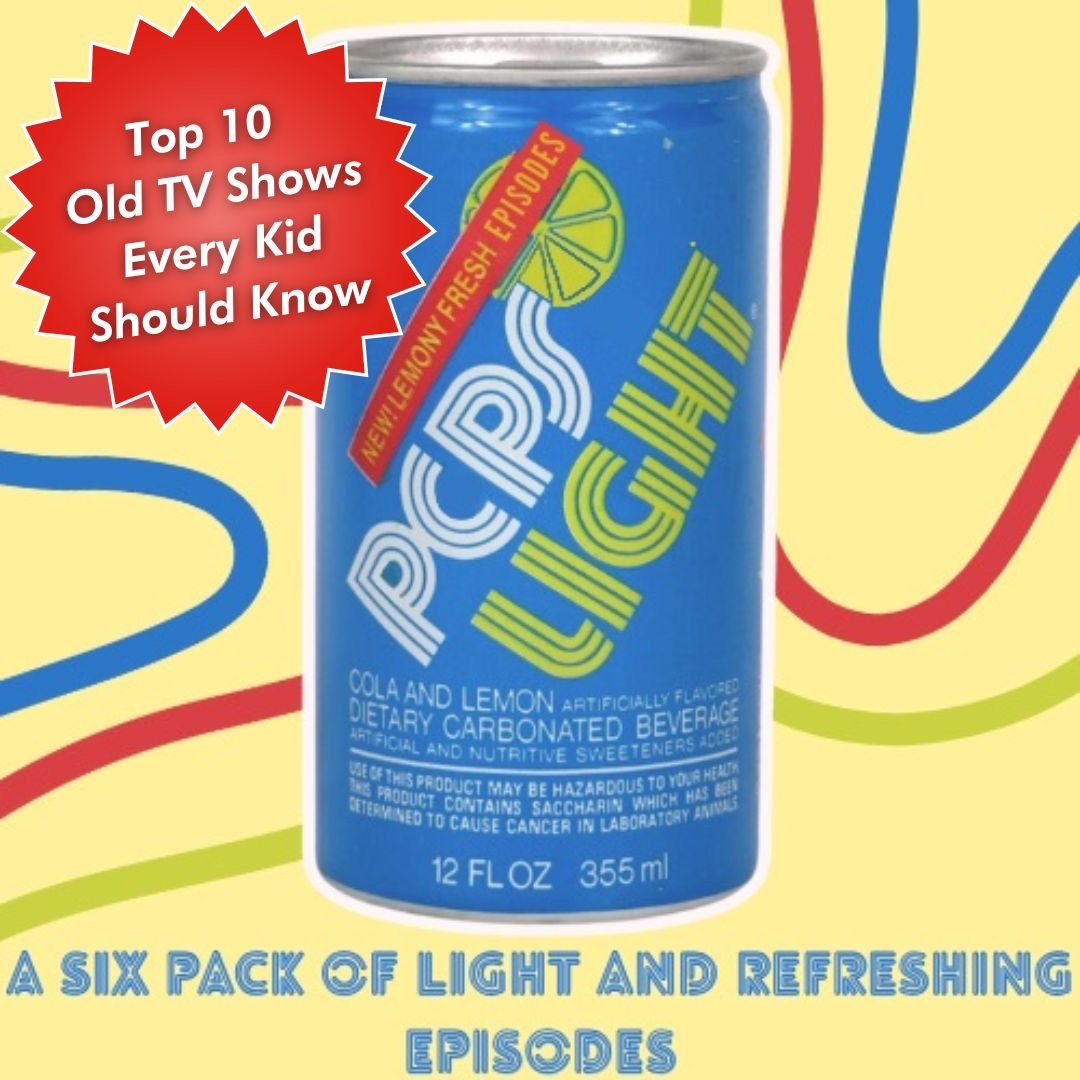
Welcome everybody. This is another. What is it? It's a PCPs light, say, another Pepsi light. It's another Pepsi light.
Michelle Newman 1:06
It sounds like people wonder why we keep putting the jingles. It's because it sounds like PCPs light a little bit. And if you look at our little logo, we made the can look just like
Carolyn Cochrane 1:17
us, and it's light and refreshing and half the calories.
Kristin Nilsen 1:21
Yeah, I'm totally unprepared, unprepared, un researched, unedited. That's what we're doing. Here is the name of the game. And today we'll be sharing an article from the New York Times called these are the 10 old television series every kid needs to watch, by John McWhorter, and without even reading the piece, I was so ecstatic that someone was even talking about this. Because we talk about this all the time, like, if we don't, if we don't talk about these things, they'll disappear. Yes, and there's a real fear that so many gems will be completely unknown to kids today, because our media catalog just keeps growing and growing. We can only go back so far. And I've often wished that there was a way to, like, stop and say, Hey you guys, like, just look at this right TV show from when grandma was a kid, Joe, She Loves Chachi, yes, just so it doesn't get lost to history.
Michelle Newman 2:20
Little salty that wasn't on his list.
Kristin Nilsen 2:25
And we knew, we knew a lot of shows from history because of reruns, because of after school TV, and we only had four channels, and there was nothing to watch, and there was nothing to do because we had no homework and no activities, and mom was at work until 530 but now that's not the case, and there are so many choices. How would a 10 year old ever find Leave It to Beaver it's just not gonna happen unless we make a concerted effort. He but he also emphasizes, like there was a lot of crap, like there's a lot of cheese ball, but that doesn't mean that it's not historically significant, exactly. It doesn't mean that there's nothing that we It doesn't mean that we can't learn something from it. And so a lot of his list is just about he's not saying this is a best of the best by any means. He just thinks that if kids get an opportunity, opportunity to see one episode of each of these shows, they'll have a little taste of what the early days of media were like and they'll be better for it.
Michelle Newman 3:22
Yeah, he says, actually, well, it's all about exposure. You'll get that if you if, and this, this article will be linked in our show notes and in our Weekly Reader this week. But he actually says most of the shows were tripe, but some of it was great, and I love how he says and some of it was a useful lesson in social history. That's the point of this list. Like Kristen just said, it's it's not to say to your kids. He did this for his kids, by the way. It's not to say to today's kids. These are the 10 Best shows. It's to say, I want to expose you to 10 different genres, maybe, or styles of the past. It's almost a history lesson. Is what it is,
Kristin Nilsen 4:04
and it's so, so interesting. And I think if we approach it that way, instead of being like kids today, they don't know good TV when they see it, you know it. That's not what we're saying. No, we're it's, this is a social history experiment, which, you know, that's why we exist. That's why the PCBs exists.
Carolyn Cochrane 4:23
I think this episode and after reading this article, no time have I felt that our job on this podcast is more important than it is. This just really made me see how important preserving these moments are not just for us, but for our future generations. And I think we as Gen X kind of this bridge generation. There's nobody quite as unique as we are to be the people that can create this again, this bridge to at this point, our grandkids, like. If we can do that and then make them have exposure to these, make them available. We're not again, like you said, Michelle, saying these are the best TV shows ever, or anything like that, we are exposing them, and hopefully, then they will take that and they'll maybe do their own work with it, and then maybe they'll show their kids. And maybe we can be this bridge that we don't lose some of these shows and programs, because
Kristin Nilsen 5:28
just losing knowledge of them, right, right? Just you don't have to. We're not asking the kids to become fans of the show or watch the whole series, yeah, just become knowledgeable of it, that it existed, and what it meant in that time. But you're right. We are the bridges, right. We're the bridges generation.
Michelle Newman 5:44
To your point, Carolyn, like how I said the author, John McWhorter, did you say McWhorter, it's like H who like a Whoville, like McWhorter, how he says, this is a useful lesson on social history. Think about our episodes where we do a deep dive onto a movie, be it Saturday Night Fever or Purple Rain, where we are really a little bit struggling with the themes and the top was Urban Cowboy. Wasn't execution or the execution of it, but yet we ultimately go back to the time, and we have to respect the time. And it can be something as deep as, yeah, our dissection on Saturday Night Fever. It can also be as almost jokey as ice castles when we're talking about she was 16 and he was 32 and then we or Blue Lagoon, and we remember, it is about, it's a, it's a it's a look into the social history of the time and and the the media, what was acceptable at the time, and that's history.
Kristin Nilsen 6:48
Yeah, you feel like a vacuum. Yeah, right. No, it came before.
Michelle Newman 6:53
Lessons to be learned, right? Yeah. Imagine
Carolyn Cochrane 6:55
the conversations that you can have with in this case, it would be our grandkids, is kind of what I'm thinking. Like, imagine the conversations that you could have that could be prompted from these episodes, and you can explain, Well, you know, back then in the 80s or 70s, or if you're gonna talk about, like, I Love Lucy, it makes me so sad to think that there might be a generation that does not know about I Love Lucy
Kristin Nilsen 7:21
that doesn't know? Yeah, well, and so to your point, our countdown, it's not really a countdown, it's a list. It's just shows and and possibly episodes that he exposed his tween daughters to, and in that number one spot is Lucy and Ethel and the conveyor belt at the candy factory. He calls Lucy the first big television hit. That still makes sense. And I love that, because if you do go back and watch Lucy, the genius becomes more apparent now than it ever has in my entire life.
Michelle Newman 8:00
Yeah, he says it's the show is also instructive in depicting an antique stage in gender politics. Yeah, because think about not just the candy episode, but so many episodes that that do kind of highlight that. And I do love all the again. We're gonna, I'm gonna just reiterate this. Listeners. This list we're giving you is just his list. I mean, yeah, he says it's very subjective. And he says, in fact, half the fun is then you coming up with your own list. This is just his list. I actually agree with many of them. Some of them I would kick off the list. I'm just gonna say, I'll tell you which ones they are when we get to them. But he said, Lucy, for sure, is hands down, a show that kids should watch, and I think they would still like it.
Kristin Nilsen 8:46
If you like humor and slapstick, this woman doesn't. It doesn't get any funnier. Yeah, and to your point about the, you know, the gender politics, he said, one question that his girls had was, how come the women don't go to work? Well, this is a great opportunity to talk about why that is. And of course, the irony being that Lucy was at work, and Lucy was in charge, right? Lucy headed that studio. She was the head of Desilu studios, and she was in charge of making TV shows that became classics. I mean, she's, we have Star Trek because of Lucille Ball, and yet, in her own show, she is a kept woman.
Carolyn Cochrane 9:27
Yeah, she is. And you know what I remember from dinner show enough to probably even bring it up with my mom. I just never thought that Ricky treated her very well like the way he talked to her, kind of condescending and kind of knowing, even as a little kid, this doesn't feel right, like she didn't do anything wrong. Why are you talking to her like that?
Kristin Nilsen 9:47
Or Lucy Yes, like she was a child, she really infantilized her yes, yeah. And they talk about that being part of his machismo, but clearly it was acceptable to put that. It on TV, and Lucy thought that it, and Lucy submitted to it like, Yes, this is the image that we're portraying, because this is what America thinks, a
Carolyn Cochrane 10:07
relationship when we watch this. I mean, this is almost even more of a reason to show these older shows to our grandkids or whatever, because I knew this was this felt wrong in the 70s, watching this as, you know, a young girl growing up like, Yeah, and so it made, made me kind of think so things had progressed, I guess.
Michelle Newman 10:30
Well, again, it's a useful lesson in social history. It's still very much a commentary on gender roles in you know, that time, what
Kristin Nilsen 10:39
if you could show this in school. Think of the conversations you could have in school in like a media studies class. But I did Media Studies in ninth grade, so you can show this to kids young enough to be able to, I don't know.
Carolyn Cochrane 10:53
Yeah, a history class. It's a history class. History could be taught through a really good TV show or whatever, that people would maybe understand it even better.
Kristin Nilsen 11:04
And then when you talk about, you can talk about that hand in hand with the candy factory and trying to fit as much candy in their mouth, and the conveyor belt speeding up and and the stomping of the grapes. And what I would, I think, as time goes on, this become becomes more clear. I, in 100 years, I would like to do, I would like to have them to proclaim, you know, who was the funniest person who has ever lived. And it might be Lucille Ball. It could, you know, I just as time goes on, there's nobody. She becomes funnier. She gets fun. Yeah, okay, in the number two spot. This is a really, really prophetic, poignant, important addition to the list, because as we record this, we're reeling from the news about Rob Reiner, reeling like we're having trouble, trouble, holding our heads up.
Michelle Newman 12:02
Yeah, we this was, we're 24 hours. After less than
Kristin Nilsen 12:06
24 hours, it's in the number two spot. He has all in the family. And to look back at Meathead, the role that Rob Reiner played, and what he meant to the world at that very turbulent time, what he was portraying, again, another history lesson that's instructive to kids, and I have, on more than one occasion, called Liam meathead, because, like, to his face, because of the altercations that we're getting into, because of the cause of the day that he wants to, you know, school me about thinking that I'm the fuddy duddy, that I'm the person that, that I'm the Archie Bunker. I'm like, I'm not the Archie Bunker in this scenario,
Michelle Newman 12:45
yeah, yeah. And meathead, isn't it interesting how you know, ultimately, so many of the qualities that meathead possessed really were things we saw in Rob Reiner, as as he grew older, and especially the advocacy over the past. You know, I don't know how many decades, couple of decades, I will say so all in the family, 100% this should be included on here. I've said this before when we've talked about all in the family. I think it's when we talked about that awful episode, the very tragic episode with Edith, where she was raped, attempted rape, attempted rape. Yes, she did. Oh, she did. That's right. What I was going to say is, I don't know where I watched this show, because this would not be a show my mom would head on. So again, I have to go back to was at my dad's the only really saving grace for me in this show. What got me to watch was where GLORIA And meathead loved them so much. I don't know if it's because they were younger. I think it's because I will always go back to the grumpiness, the arguing. I had enough of that in my real life, so even as a very small child watching a television show, I wanted an escape from that. That's why I latched on hard to a Little House on the Prairie and Happy Days and, you know, but loved GLORIA And meathead. So that's just my little that's not anything about social history or anything. That's just talking about how those characters are memorable to me, but they did kind of worm their way into my, you know, being I think, yeah, oh yeah.
Carolyn Cochrane 14:18
Well, and that show, really, for my family, I've said many times what Saturday nights were like growing up with the dad grilling outside. And that show, I remember conversations that I would have with my mom or dad after that show, it would prompt things for me to say, Well, what did that mean? Or, gosh, why did they say that? Or why are they acting weird that this is their neighbor, or it truly brought up things that were in current events that I could then ask about, and my parents could explain a little bit to me. I think it's where I learned about maybe even like Vietnam, like what that meant. You know, the word was out there. But. For but then you'd hear meatheads, you know, stance on things, and you'd hear Carolyn O'Connor getting all snippy. And I'd be like, Okay, well, why? You know, like my parents could then take stuff from that show and explain it to me a little bit better. So another reason why these shows were so important beyond just entertainment, they were, they got us to have conversations and learn
Kristin Nilsen 15:26
it was like current events without watching the news, right? And you could see people's real reactions to current events in real time.
Carolyn Cochrane 15:34
And I wasn't watching the news when I was because you were a child,
Kristin Nilsen 15:37
yeah, but you got to learn about your environment, what was happening, and your parents take on it, right? Which is important. The analysis of it is really important too. And that's really what meathead and Archie and Gloria were all about. Yeah. And the author of this article, the episode that he recommends, is the one where Sammy Davis, Jr kisses Archie, and I remember too, like that to me, was probably my first lesson in racism, like, I didn't know what that was. Why didn't he want Sammy Davis Jr? Like, what? What did he have against Sammy Davis Jr? And I remember talking to my parents about that, and I it was sort of like the Wizard pulling back the curtain. You're like, Well, why is Archie like that? Because that I was unknown to me. I didn't see, I mean, of course, that existed around me, but I didn't see it because I was a child, so that, and that is a that is, I believe, in the article, he says, this is an important moment for my kids to see how racism was presented on TV as we're talking about it, right? Yeah, you know, like we're putting it out there and it's on a sitcom, and we're gonna laugh in the number three spot, he has the Jeffersons, because this is the first time that we saw we the viewers, saw rich black people on TV. You know, there are lots of shows about lots of different kinds of black people, because, of course, they are not a monolith. There are many different kinds of people. But up to that point, the black people on TV were kind of shown in one light. And this was the time where they were like, nope. Black people are rich people too. And then there were also the willises, the first interracial couple on TV. And the which was fascinating to me too, because, of course, we didn't know that was an issue too. What do you mean? What do you mean? They don't people don't like them to being together. Why? Mom? Tell me, why? Right? And the episode that he is promoting, or the episode that he is saying that kids should watch, is the one where George meets the clan. I don't remember this one, but he does say, this is a quote from him. He says it illustrates the ugliness of the N word, and does so without the pretense that to use it on a TV show or to refer to it as a phenomenon is the same as using it as a slur, whereas today you can't say it out loud no matter how you're using it. They said it out loud on the Jeffersons. They were saying that this is a really, really, really, really bad word, but they're showing how, yeah, right, how our lines are drawn now, in a way that maybe don't make sense. I mean, don't use the word people, but Right, yeah, do you know what I'm saying? It's very loaded. It's very loaded like, in order to understand the depravity of the word, you had to hear it out loud. Okay, moving on in the same vein, in the number four spot is Amos and Andy, which was a show that my dad talked about all the time, but we never watched.
Carolyn Cochrane 18:31
I've never watched. I don't even know that we it's not like I ever stumbled across it or anything. No, we know
Kristin Nilsen 18:38
that it was to be really old. Yes, I think it is early 50s, late 40s, because it started as a radio show and then became a TV show. And the way the author talks about this, he says, drop in on a time in contrast to the Jeffersons, when the only portrait of black people on the air was about buffoonish, underemployed shysters played, by the way, by white men in blackface, remember?
Michelle Newman 19:03
But again, a very interesting history lesson. That's right, we can disagree with it, which we all do, and I'm sure everybody listening does, but it's also it is a reflection of a time in history,
Kristin Nilsen 19:16
and why people thought it was okay then, and why we know it's not okay now, yeah?
Michelle Newman 19:21
How all of our social constructs have changed and things are different, yeah, right.
Kristin Nilsen 19:27
In the number five spot, he has the Golden Girls. I
Michelle Newman 19:30
love that. He put the Golden Girls on here. I wouldn't put it on my list, though. I have nothing against the Golden Girls. Don't come at me. I'm just coming at you, right? Well, yeah, the same people that came at you Yes, many episodes ago when you said you weren't, didn't really, yeah, but I, I like the golden girls just fine. I used to watch it all the time. Laughed my head off. I'm just saying. I don't know that I would put it on my 10 most important TV shows. He said, That's where Joni Loves Chachi goes. Guys have. Course, yes, because that definitely belongs, because obviously
Carolyn Cochrane 20:03
personal aspect to this, you know, these lists too, so,
Kristin Nilsen 20:07
but I like his reasoning. First of all, he says that the Golden Girls. He says, Every episode is perfect, and I just, I love that that shows such bias. He's like, I am who I am. But the reason he says is that the Golden Girls exemplifies the very special episode which we've talked about this before, so many very special episodes to an end that it shows the the TV formula of the day, which was kind of this harsh, unnatural lighting, formulaic theme songs and transitional music between scenes, which before he said that I had not even clocked that as nothing over the time. Yeah, it's like the Brady Bunch thing, like, yeah, when someone
Michelle Newman 20:53
was gonna get in trouble, right, right? But that was way before Golden Girls. So that was also that they had done that for a long time.
Kristin Nilsen 20:59
I'm lumping that in the same time period. Oh, 70s, 80s, yeah, and he chooses the episode that his children will watch as the one where Blanche begins menopause, which I think is such an interesting choice.
Michelle Newman 21:13
I think it's interesting too. And the reason I just have my head in my hands right now is because you guys from season one. In my mind, Blanche was like 68 So grandma Yes, they were grandmas. So when you actually go back and see how old they were, they were, like, our
Kristin Nilsen 21:29
age. Oh, my God, it's all about the hair,
Carolyn Cochrane 21:33
about the head. Lesson, yeah, tick teacher, you know, grandkids are showing this like, this is how they you know, back in the 80s and 90s, they thought old people, yeah, old people. They thought a 60 something year old person should dress and look how cool your grandmother dresses in her 70 me.
Kristin Nilsen 21:52
Yeah. I mean, well, even right now, because we are of the age that The Golden Girls were quite literally on TV at the time, and you can say, okay, look at me, right. Look at Blanche. Look at me, look at Blanche. Are we the same, or are we not? What is old? What is it? What does it mean to be 57 now, what did it mean to be 57 then, yeah,
Carolyn Cochrane 22:12
general, that's we've lived through a big leap, and we've been the benefit of that we've got today.
Kristin Nilsen 22:17
I mean, wouldn't it be fun to have a party where you showed up as 1980s 57 if you dressed like what you would have looked like in 1960 or 1970 Yeah, it's a Yeah. Actually, it's kind of frightening. I'm not sure that would be fun. It's a wake up call. Okay, in the number six spot, we have cheers, which he calls a pioneering workplace sitcom.
Michelle Newman 22:43
Yeah, I can see that. I don't think I would have it on my list. I love that's one of my all time favorite sitcoms. Love it so much, but I'm not sure I would put it on my list. He also, you know, says, Because cheers was truly an ensemble. I mean, you did have, he said Mary Tyler Moore, which definitely was a workplace sitcom, but it was focused on Mary. It was Mary's show, yeah,
Kristin Nilsen 23:06
whereas this isn't anybody's show in particular, you'd think it would be Sam, because it's Sam's bar, but it really isn't. And every single one of those players has its own story arc. They have their own episodes every single person. And so he calls this an ancestor of the office? And then everything that came after the office, right? Which we're now seeing a resurgence of after the office, came Parks and Rec. We had 30 rock now we have animal control, we have st Denis medical, we have DMV, we have the paper. All of these are trying to replicate that workplace comedy, because
Michelle Newman 23:40
it works. Yeah, totally works. I mean, it's, it's good fodder, yeah, it is, no doubt about it,
Kristin Nilsen 23:47
and it, I think they're coming back to it because, maybe because of us, because this is how we learn to laugh, and because they haven't found anything funnier. And so like, Fine, let's just go back to the office and we'll just do it again. Yeah, in the number seven spot, this is such an interesting choice, and I totally agree with it from an from a history. I love it. Yeah, I love this choice. In the number seven spot is the Twilight Zone, which my parents loved to share with us. It wasn't that they loved the Twilight Zone. They love to share the Twilight with us.
Michelle Newman 24:24
Yeah, there was a couple of years and I don't remember how old I was. I'm gonna I'm gonna say I was probably in about, like seventh, eighth grade, and it was on at like 11 o'clock at night or something. And my sister and I just we would watch it every single night, like we loved watching the Twilight Zone.
Kristin Nilsen 24:41
It's a great way to go to bed. It's a great way to cap off your night. And he says, I this. This just gives me so much more to think about. He said, this was Freud and young on TV, like they were taking people's psychological mechanisms and they were twisting them. And turning them so, because they had to know how psychology works in order to adequately freak us out. Yeah? Well, yeah, how to make us go. The one that I remember being most freaked out by was when the there was a woman on like an operating table, and she'd been horribly disfigured, and she had to have all this, this plastic surgery, and when they removed her bandages, everyone's like, Oh no, oh my god, she's hideous. And she looks like, basically Marilyn Monroe. And then they turn to show the doctors and the nurses, and they all have pig noses, pigs, yeah. And it just freaked me out. Beauty is in the eye of the beholder. Well, what
Carolyn Cochrane 25:44
about the one that will always come to my mind is the William Shatner one on the airplane where he sees that scary thing on the wing? Yes, I think the part that gets me is I knew it was there like I felt so bad for William Shatner, because I wanted to go I saw it too, but no. So horrible for him, because it's like they're trying to tell we're supposed to think it's not there, and then they put him, like, in a straight jacket at the end, I'm like,
Michelle Newman 26:14
No, it really was there. I saw. How
Kristin Nilsen 26:19
do I call the cops exactly in the number eight spot. This is really an interesting one, and it made me laugh, because this was one that my parents watched in the number eight spot. He has manics.
Carolyn Cochrane 26:35
I liked his reasoning for me. I did too. I did too a lot.
Kristin Nilsen 26:37
Yeah, his reasoning is very good. He says kids should know the conventions of the once ubiquitous hour long Private Eye genre. It's true how many of those manics, Barnaby Jones, Colombo, so many, and he said early on, he says they really reduce he wants his girls to see how these shows reduced women to dolls, which I wouldn't have thought of because I didn't watch these older shows as much as my parents did those. Those were after bedtime shows, and he wants his girls to see that. You know, progress has been made. This used to be the way people thought about women. But then, of course, as we grow up, we see the birth of Cagney and Lacey and the female cops on Hill Street, blues and murderous
Carolyn Cochrane 27:23
woman? Yeah,
Michelle Newman 27:25
I was gonna say I appreciate his inclusion of Mannix. I would either replace it or add also Charlie's Angels to my list.
Kristin Nilsen 27:34
And Charlie's Angels, it should, you're right, hit because of his reasoning. It should be paired with another show. Yeah, that is absolutely true.
Michelle Newman 27:43
Number nine is just such a great inclusion. I think number nine should be right up there in numbers one, two and three, but that's the Carolyn Burnett Show, and his reasoning is the kids should catch at least one episode of the grand old genre of variety shows. But I'm gonna add in the whole reasoning of like, Lucille Ball and everything. I mean, just showing that this one woman was in charge and basically ran this whole show and carried the show, oh God, just and some of the best, and I mean, the most quality comedy too I would want to be teaching my kids. This is a great example of, like the perfect pratfall or the perfect joke or the perfect expression on your face.
Kristin Nilsen 28:27
So, yeah, I think how to manage an audience with all that? You know, it's live. You hear. They have to wait for the laughter to pass. This isn't mockumentary. This is real. Not that we were watching it live. It was recorded, but it was in front of an audience, so they didn't do take two. They had to wait for the audience to stop laughing and figure out how to time all of their gags. Yeah, it is. It's old school comedy, but it is foundational comedy. And I want kids to see foundational comedy right now. What they think comedy is is falling on the ice, on tick tock.
Michelle Newman 29:01
Well, that this this specific type of variety show, also it's such a precursor to something like Saturday Night Live like a skin, yes, a sketch comedy show. We'll just say The Carol Burnett Show is such a great example of quality sketch comedy pre SNL.
Kristin Nilsen 29:19
Pre S is a different they're two different apples and oranges. I'm gonna say A's and B's. That's not right. Apples and oranges, they can't be compared. Yeah. And then what's in the number 10 spot?
Michelle Newman 29:29
Do you have it? Carolyn, I don't. Oh, okay, so, and the number 10 spot, I don't know, yeah, number 10 is faulty towers,
Carolyn Cochrane 29:39
which I don't even know what I just
Michelle Newman 29:41
basically the author is saying. It's, this is a time where the britcom was an exotic bird, different pacing, humor and language from what Americans were used to. And that's and, and, yeah, I guess so sure, I don't know that that's one that I need to. Show my
Kristin Nilsen 30:00
kids as like, yes, and it would you try to watch it when there was nothing else on, and so you would turn to the PBS station, and you would try to watch it, and then you would just turn the TV off. Yeah, and I'm not saying that there's anything bad about faulty towers or that, I'm just saying as a child, right? That was my behavior if I watched it. Now, I might think it's hilarious, and I'm and it probably is, but at that time, you know, it wasn't Benny Hill and I was maybe I
Carolyn Cochrane 30:29
didn't even really like Benny Hill either. I didn't like any of that British comedy stuff. Yeah, it was a reason
Kristin Nilsen 30:35
droll is hard to get when you're
Michelle Newman 30:38
I'm gonna disagree with him on something. When he said he would show and not not disagree, but just add my own opinion to the inclusion of cheers, showing it as such a solid ensemble show, I'm gonna go back and I my choice for that's gonna be Gilligan's Island. And I think because there's another show where every character had a backstory, and they did some interesting things on Gilligan's Island that I'm not sure had really been done like that before. Remember how they would always do like little dream sequences, and I would say, you know, three out of five episodes, they're imagining what it's going to be like when they're off the island or whatever. But also, every character on that show had a solid care, a solid, you know, story, a solid backstory, a solid character. So that's a true ensemble. Yeah, so I'm gonna replace it. I'm not gonna say he's wrong for including cheers in his list. I'm gonna say I'm gonna replace cheers if we need to fill an ensemble category. Mine's gonna be Gilligan's Island. I do you guys have any other ones that?
Kristin Nilsen 31:42
And Gilligan, it's called Gilligan's Island, so, much like Mary Tyler Moore, it's called Gilligan's Island. And we just called it, of course, Gilligan. So it was Gilligan's show. And yet, you're right. They gave every single person there, yeah, every line, but again, apples and oranges. I do think cheers has to be on this list, but I also think Gilligan has to be on
Carolyn Cochrane 32:00
the list. Yeah. And, you know, I guess too, when I've been when I was thinking of the list, I was thinking of showing this almost to kids like, you know, when we watch Leave It to Beaver and The Dick Van Dyke Show and all of those things, and cheers to me, would never cross my mind as being like an after school rerun kind of show.
Kristin Nilsen 32:20
No, it's a 1030 show right after the news Exactly.
Carolyn Cochrane 32:24
So I guess if I'm showing it to my older, an older generation of children, I could, you know, I can envision that. But in my mind, when I was thinking about some of these, I was thinking about the shows we got to experience because they were reruns, and how, you know, we can still say Eddie Haskell. We know what that means. We didn't watch it in real time, but it was, you know, a syndicated rerun show that left to kids. Yeah, right. And our, you know, the generation of kids now won't never have, really anything like that. And so that's how I looked at these 10 shows. Is what, in a way, would be a show that could come on now in syndication, that our kids could be exposed to, that they would learn about something.
Kristin Nilsen 33:10
Yeah, and that's like that the it's interesting that he doesn't include mash, and I think it's because of that point Carolyn, because, much like cheers, mash was a 1030 show. That's an after the news show. I would show that to my adult children as a form of historical reference. I'm not sure his tween daughters are going to get cheers or think it's that fun. He's kind of got a
Michelle Newman 33:34
mash up of child shows and adult shows would never be a Yeah, no, no. And if this was not a PCPs light episode, which we need to be wrapping up, I would say if this was a regular episode, we would have each come with a list of maybe five shows, and that could be something fun, maybe to do
Carolyn Cochrane 33:53
with that list. And so, yes, stay tuned for a future that'll
Kristin Nilsen 33:57
be an episode. We're gonna do our own list. We're gonna make our own list.
Michelle Newman 34:00
Forget everything I said, especially, Joni Loves Chachi.
Kristin Nilsen 34:06
Thank you everybody for listening. Today, we will be back next time with another PCPs light, I think, depending
Michelle Newman 34:12
on when we air, this might be the last one. Who
Kristin Nilsen 34:14
knows, and we're not gonna edit that out, because it's enough. So in the meantime, let's raise our glasses for a toast, courtesy of the cast of Three's Company, two good times, two Happy
Carolyn Cochrane 34:25
Days to Little House on the Prairie. Cheers, everything, which would be one of my shows you.
Kristin Nilsen 34:40
The information, opinions and comments expressed on the pop culture Preservation Society podcast belongs solely to Carolyn the crushologist and hello Newman, and are in no way representative of our employers or affiliates. And though we truly believe we are always right, there is always a first time the PCPs is written. And produced and recorded in Minneapolis, Minnesota, home of the fictional wjm studios and our beloved Mary Richards, Nanu. Nanu, keep on truckin and May the Force Be With You. You.